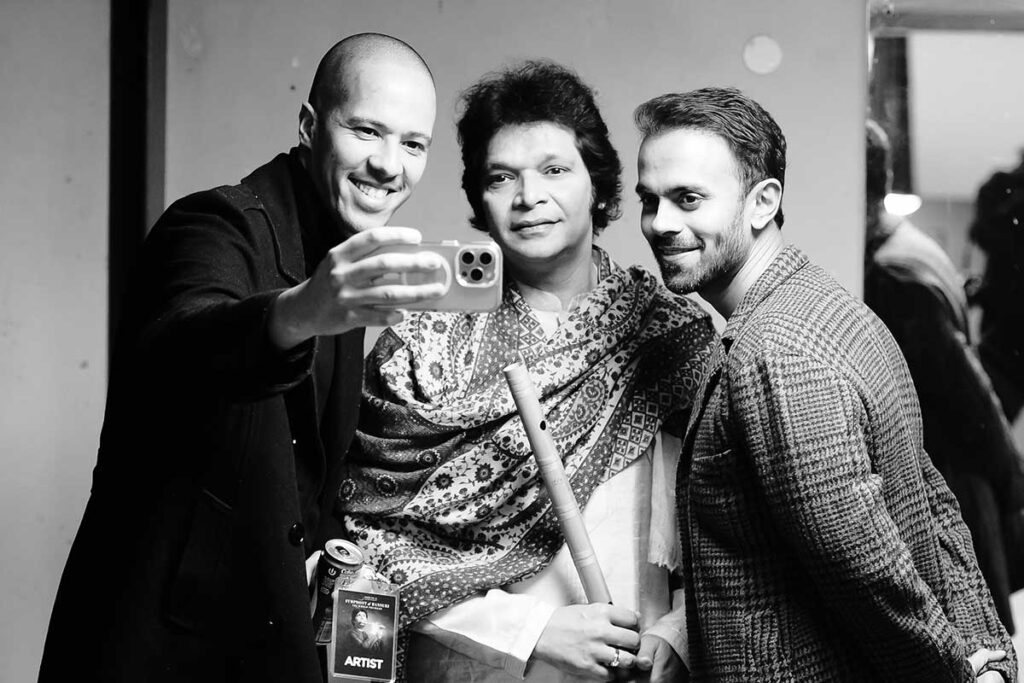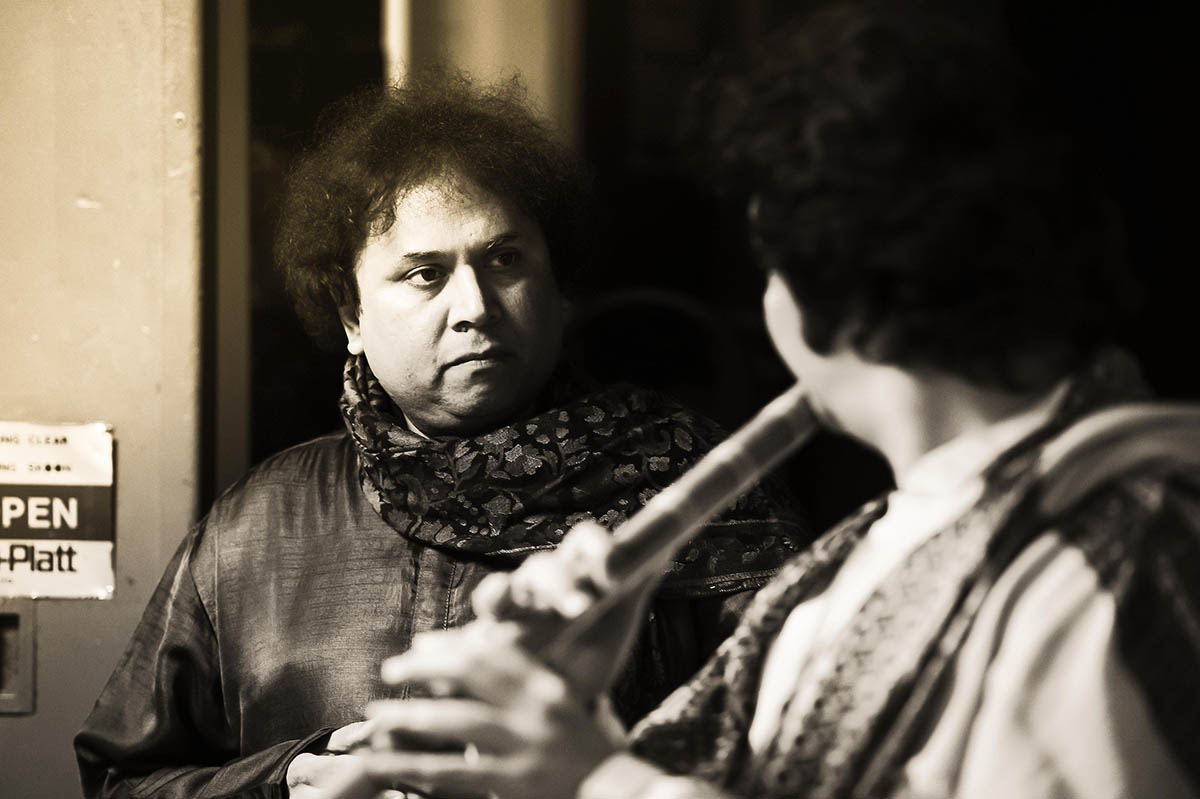
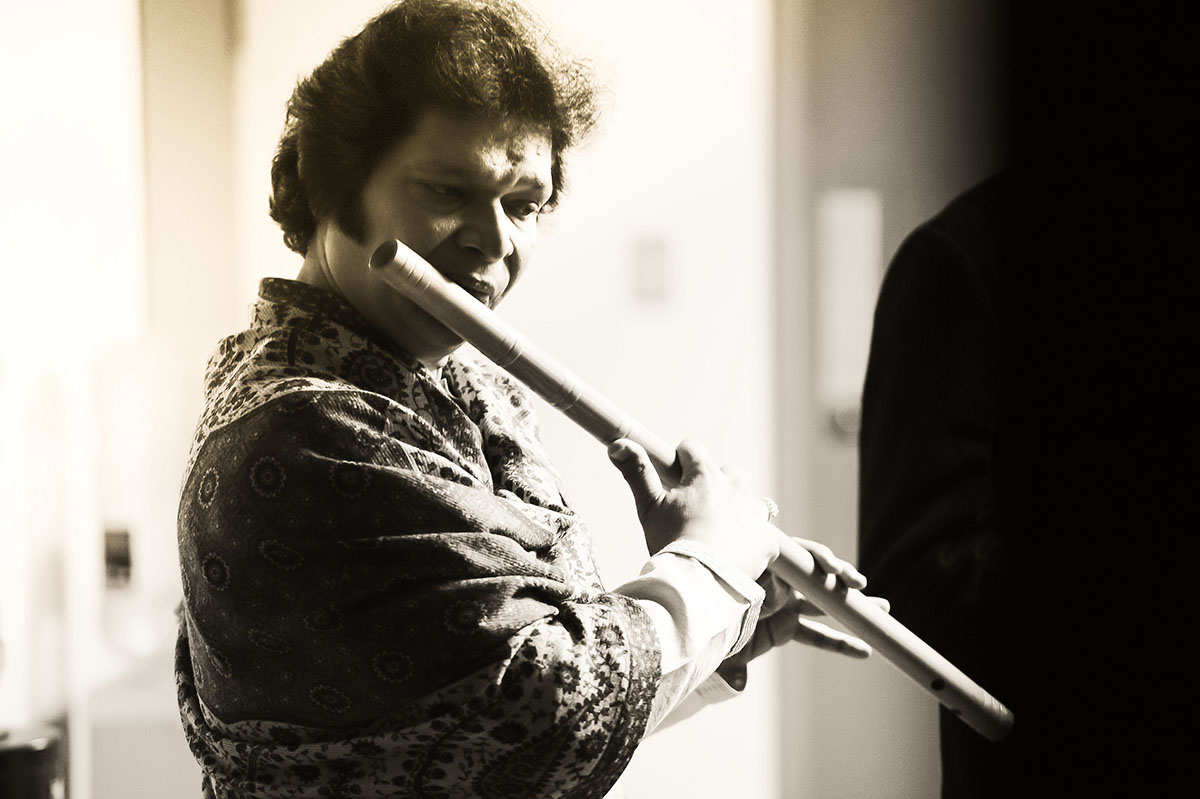
CONCERT REVIEW: SYMPHONY OF BANSURI. Rakesh Chaurasia (Bansuri Flute), Satyajit Talwalkar (Tabla), Sangeet Haldipur (Piano), Jonno Sweetman (Drumkit), Cape Town Philharmonic Orchestra conducted by Damian Philander. 2 August 2025, At Artscape Theatre, Cape Town. ALBERT COMBRINK reviews.
It was a treat and a rare opportunity to dive into the exotic and alluring music of India, when Rakesh Chaurasia brought his latest project to Cape Town. A product of various converging dreams and visions, the idea was to create a fusion of Indian Classical music and the traditional Western Classical Symphony Orchestra.
Interviews and programme notes stressed the usual ideals with these types of events – music unifying humanity, exploring common ground, and Chaurasia states his own creative vision as “rooted in unity through contrast”. How successful this was, remains in the ear of the listener. Chaurasia says “As I always say that we are the two sides of a country which present the classic form. So, the Indian culture, heritage music, the classical form is very strong and the Eastern classical form is very strong. So why not bring them together?”
Two concerts
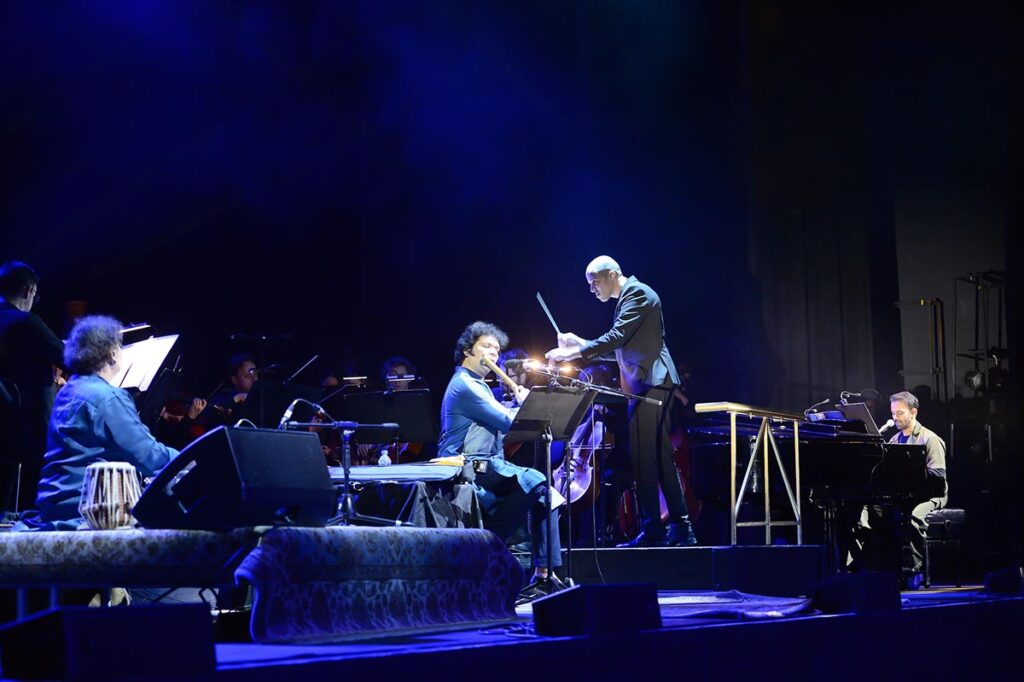
From an experiential perspective, the concert deviated from the traditional Symphony Concert. It was in fact TWO concerts: the first half only had flute and tabla presenting two Indian Classical Ragas, and afterwards, a series of works for jazz ensemble (drums and piano), Indian instruments (tabla and flute) and Symphony Orchestra.
A product of Inner Circle Entertainment, the biggest producer of Indian Classical Music concerts in South Africa. They put on a slick production, that is for sure. Speeches – some longer than others – made for a slightly later evening than required. A giant screen advert for sponsors Ethiopian Airlinesand Taj Hotels opened the event like a live YouTube stream. Rola Volvo, IBV International Vaults and Polar Ice Cream banners made the foyer look festive, while providing the one thing without which none of this artistic endeavour would have been conceivable. I could imagine the traditional concert audiences have something to say, but if the sponsors step in where government has dropped the ball, then they deserve all the airtime they get. Perhaps this is a serious consideration for the more traditional classical arts organisations, going forward.
The concert was lit like a rock-concert – very beautifully and effectively – as well as amplified. Once or twice the flute overpierced, but the parameters remained within the range of a concert, rather than a pop-concert. Plus, the audience were clearly made up of people who knew some of the songs, and some audience members were sadly absent because of what they perceived classical Indian music to be.
Another main difference was that the actual “Symphony of Bansuri” was not a single work, but rather an orchestral suite of eight numbers, composed by three composers (Rakesh Chaurasia, Sangeet Haldipur, and Luca Russo) – excluding those composers in the Bollywood Medley – arranged into a satisfying orchestra unit by Marvin Bourne (Sadly, NO programme CV’s of composer Russo or arranger Bourne, and not, for that matter, of the conductor either).
Programme notes were appreciated, but to be fair, in the dark, one simply doesn’t read them and the guidance from the artists themselves is not only welcome, but essential. A multi-composer work like this would only work with an arranger with a firm grip, to pour it all into a stylistic mould that binds the separate voices together. Marvin Bourne did an excellent job and no movement stood out as not feeling like an integral part of the whole.
The first two numbers were based on traditional Ragas (basically a tune or scale, on which artists are supposed to extemporise and develop ideas. A “Reggae Raga” put us firmly into the Cross-over World Music category, with a delightful foot tapping energy. The first three numbers were by Chaurasia, arranged by Russo.
The comparison with Jazz symphonic works arose with the fourth song “Dance with me” which created extended spaces for the soloists to improvise. Haldipur is acknowledged as “co-composer”.
A Bollywood interlude followed, with the Indian instrument trio alone – no orchestra. The Bansuri flute is, of course, an integral part of Indian film music, so perhaps the inclusion of an un-orchestrated, intimate chamber-music moment in the midst of a larger canvas, was a good palate cleanser. Cape Town’s Indian community showed their love and appreciation with some very lovely humming along to tunes clearly recognised by many.
“Eighth wonder of the world”
For Western Music ears, a 7-beat rhythmic cycle is complex, but in the vast world of Indian Classical music, a 7-beat cycle is quite straight-forward, if revered. The number 7 is seen as a symbol of completeness, perfection and spiritual fulfilment, with references to 7 elements, 7 continents, 7 colours in the rainbow…. Therefore, “Waiting for the Day”, should ideally have been the 7th number on the programme perhaps! It was dedicated to what Chaurasia called “the eighth wonder of the world”, his friend and co-musician of many decades, the late Ustad Zakir Hussain – one of the main encouraging figures behind this entire project. The recent loss of this giant is still felt in the musical world, and this tribute to his memory was one of the highlights of the concert.

Two fast and virtuoso pieces concluded the programme. The second half felt a quarter-hour too long, mainly the long interval and the speeches stretched things too much. Hearing the musicians talk about the music was worth gold, and the orchestra played the complex music with precision and excellence. Damien Philander always had every tempo and tempo-change in hand, and the sound and amplification was handled brilliantly. Xylophone solos and seductive harp interludes or a dramatic horn melody came across clearly.
Much as there was to enjoy about the second half – was it THE “Symphony of Bansuri” or was it a Suite for Bansuri and Orchestra, or was it merely part two of an event named after its constituent parts? – the entire Symphonic half of the programme was click-track, and more than three-quarters of it required a drummer. That click-track locks it into a genre somehow – I am not qualified to give it any more names than I already have. I have no complaints, and would happily hear the works again.
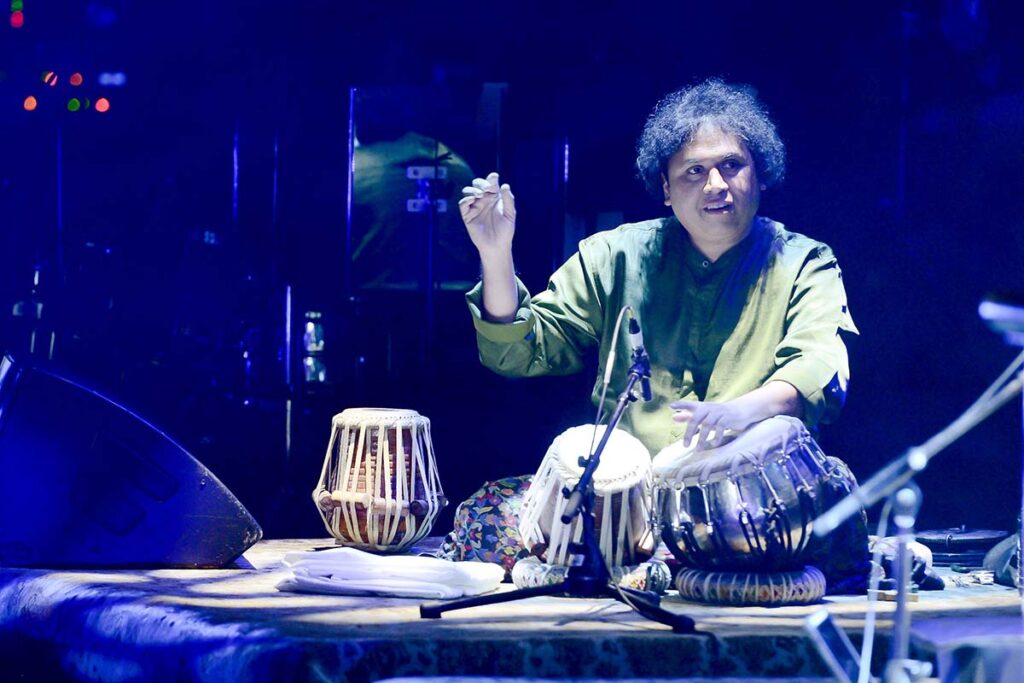
The first half of the concert held – for me – the gold of the evening. Rakesh Chaurasia, sitting on the floor with his flute (s) – with his santoor drone playing off an iPad (it was a surreal moment, to be sure) – and Satyajit Talwalkar sitting sideways facing him, on his tablas. The lighting behind them made the two musicians look like the centrepiece of a giant lotus. I could not decide if the energy was being sent from them to us, or if they were drawing it from us unto themselves, but the music called forth engagement and focus. I can just say we were treated to two magnificent ragas that revealed a tonal sensitivity that defies description, a musical expression so intimately interwoven with emotion, that the two became inseparable.
To say the technical ability was astounding is an understatement. The flute has no valves, no levers or buttons. It is a piece of bamboo, much like it was 5000 years ago. While the music was dancing above our heads, I imagined that molecules and atoms get recycled. When we die, we become part of nature again, and our atoms remain in the food chain. At one point I felt as if part of my body must have been around when a flute played 5000 years ago, because it felt so familiar, so comforting and so exquisite that I was afraid to breathe in case it would stop too soon. That a tabla can play pitched notes on a scale as in tune as the flute – manipulated by nothing than other than how hard one presses on the drum, is astonishing, especially to musicians in the audience who realise how difficult this feat is to achieve. The drum and flute then built up to a call-and-response dual, which had the audience gasping for joy.
A beautiful evening of music in Cape Town, with huge pride in our local musicians for being able to rise to the challenge and share the stage with a two-time Grammy Award Winner. The experience is flavoured with a tinge of sadness that our playlists are still so divided, but the event left the listeners filled with a deep sense of joy, beauty and hope.
Symphony of Bansuri was made possible by Inner Circle Entertainment.
Read Karen Rutter’s review of Symphony of Bansuri here.
What: Symphony of Bansuri – Rakesh Chaurasia, Satyajit Talwalkar, Cape Town Philharmonic Orchestra
Reviewer: Albert Combrink, Albert’s Website
WS