WHAT REMAINS. Written by Nadia Davids. Directed and choreographed by Jay Pather. With Denise Newman, Faniswa Yisa, Shaun Oelf and Buhle Ngaba. Lighting by Wilhelm Disbergen. Videographer: Sanjin Muftic.
KAREN RUTTER reviews
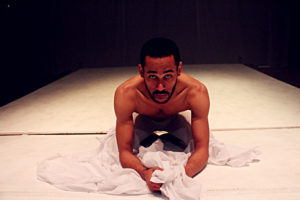
Entering the space that houses the performance of What Remains feels like setting foot in a sacred battlezone. One that sits uneasily, even angrily, between living and dead, past and present. And we assume this is the exact intention of writer Nadia Davids and director Jay Pather, to create a theatre area that evokes tension and trepidation. Although beautiful in its stark white layout, subdivided with billowing sheets, it is a place of agitation. And ultimately pain.
When writer Nadia Davids began work on what has become What Remains, she initially thought it would be a novella about Cape Town slavery, referencing the uncovering of the graveyard at Prestwich Place in Cape Town in 2003. What happened here was that a piece of land in the city centre was earmarked for development by a corporate group. But as the work started, the builders found what turned out to be a massive 18th century slave burial ground, holding nearly 3000 bodies, from babies to old people. Reactions ranged from the developers wanting to get on with the job, to heritage specialists wanting to examine the site, to activists demanding re-interment of the bones.
As Davids says in her programme notes, she understood this moment as “telling us not only about the fault-lines of a post-apartheid city but also a prophecy, a warning of just how deep our difficulties lie”.
She also says: “Cape Town’s dark beginning has cast a long and chilling shadow on the present; the morphing of slavery into colonialism and later apartheid has made it a city where, famously, its natural beauty exists in stark contrast to deep and abiding disparity.”
A tale to be told live
Davids recognised that the story she wanted to tell needed to be told live – on a stage, not as a novella. She enlisted the support of director and choreographer Jay Pather, and the result is a haunting piece of theatre told in 12 acts, using acting, dance and multimedia effects. Interestingly, while the story is intrinsically about Cape Town, it could be also be set anywhere, in a heart-breaking limbo-land.
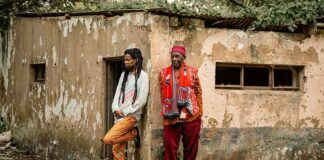
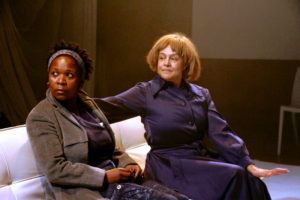
There are four symbolic characters who recount the tale – the Healer, the Archeologist, the Student and the Dancer, the first three representing different attitudes and reactions to the discovery of slave bones, the last acting as a kind of conduit between the quick and the dead. Davids’ writing, with Pather’s choreography, creates very clear and strong roles for each. Buhle Ngaba as the Student and part narrator is a bright, lucid presence; Faniswa Yisa as the Archeologist segues agonisingly from blasé scientist to anguished believer; and Denise Newman as the Healer provides a powerful pulse to the play. Shaun Oelf’s ethereal yet darkly present occupancy of the set is a constant motif, a disquieting beauty in motion. Pather’s hand is found everywhere, from the choreography to the pace of the script, which builds up to a primal scream of an ending.
Heart-breaking and impressive
While What Remains recounts a specific event, beginning with the discovery of slave bones in a city, the rendering of this is more ambiguous, a reimagining which draws on a collective and historical experience of pain which fuels contemporary combustion.
As Davids has said, there are no answers in this, only questions. What Remains provides a heart-breaking process which, like the space it is performed in, sits uneasily. It is an impressive piece.
(Just a pity it is only being performed for such a short run. One hopes it will be back.)
What: What Remains
Where and when: Hiddingh Hall until July 12
Book: Webtickets
WS