MICK RAUBENHEIMER’s Round Corners mini-interviews place artists outside their given media. He sat down with talented wordsmith Kyle Allan to chat about strange inks and seductive worlds.
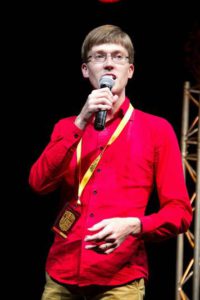 When did you first identify as a creative artist?
I wanted first to be a short story or novel writer, when I was around 14. At the time I was very interested in philosophy as well. What changed everything was reading A Century of South African Poetry edited by Micheal Chapman. I was 15. I encountered South African poetry for the first time, poets like Wopko Jensma grabbed my attention. And then I decided I wanted to do this as well, write and speak about reality in a compelling way, a way that is an extension of reality, a form that carries life within it.
When I was younger I would also draw and paint a lot, went for a few art lessons, but that was expensive, being that type of artist was expensive, whereas being a writer all you require is pen and paper. So in some ways I am a frustrated painter, and that is why I often start poems out of images, the urge in me is to paint in words. That is why physical objects are crucial to me as a writer, not so much isolated issues or abstract ideas, for me issues are seen in physical things, in living people, in houses, in roads, in gardens, in dusty yards with bottles lying around. I can write a very powerful poem about society by observing the world around me, and relating that in words. I don’t need to see what the latest trends or hashtags are. I look at what is happening in front of my eyes and also what is going on inside of me, what grows and changes inside of me.
 Outside of your medium, what branch of art most stimulates you?
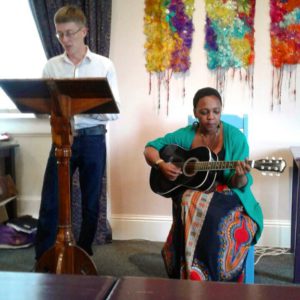
Music stimulates me as a writer. Sometimes I will just sit around and listen to music. The words, the rhythm, the notes, everything. It will often be a complete and unexpected mixture.
Other times I might play some songs over and over in the background as I write. Sometimes I turn the music off and just listen to the silence. I don’t really have a hard and fast rule for inspiration.
The main influence from music is in the understanding of the phrasing and breath of words. The relation to everyday speech musicality. And I am also very influenced by the oral delivery particularly of isiZulu poets here in KZN.
I am drawn to many kinds of aesthetics. Natural landscapes, well-designed clothing in shops that becomes a natural extension of the body’s form, the lines and forms of shoes, moving cars and taxis, the dusty yard filled with tired people. That silence in a barren landscape high on a plateau. The ways in which mediums flow into each other, creation, created and creator are indistinguishable.
Which artist/s in said discipline have significantly inspired you, and why?
In the discipline of music, if I have to pick someone, it would have to be Dylan. When I first heard Like a Rolling Stone as a fifteen year old, I had never ever heard a song like that. It was just so magical. It was just the whole gestalt of it – the sound, of the music, of the words, the feeling of it all, the attitude. In South African music, the song that reminds me most of it is Umoya by Skwatta Kamp. I am moved by music and art that has this totality.
After Dylan, Fela Kuti, Robert Johnson, Woody Guthrie, Brenda Fassie, Vusi Ximba, Roy Buchanan, the Reverend Al Green, Lennon, Ray Charles, Chuck Berry, Simphiwe Dana, Hendrix, to name only a few, are influences.
What, to you, is art’s most important function?
Art’s most important function is to communicate life. It narrates in different ways, sometimes impressionisticaly, sometimes more literally, it reorients and awakens us to reality. It resonates with the real. I like the definition of Cronin in a poem where he says
perhaps the aesthetic is the opposite of the anaesthetic. Its role is to awaken us. This awakening could take place across several layers at once.
As a reader, what I look for in a poem is that striking quality, something like Lorca spoke of as the duende, that being compelled quality to it. That is what demands my attention.
What specific work – be it in literature, music, or visual art – do
you return to again and again, and why?
In poetry, Jensma, Nyezwa, Motsapi, Moolman, Muila, Rimbaud, Rilke, Lorca, Vallejo, Okigbo.
Any current project you’re unveiling/wrapping up?
I have been hard at work on more poems. I have almost completed the draft of a novel entitled Irrelevance. A script of mine, a one-woman monologue, Mata Hari: A monologue, will be on stage by September.
Who: Kyle Allan
Web: http://kyleallanpoet.blogspot.co.za/
WS