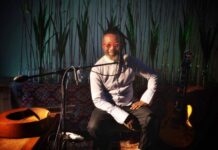
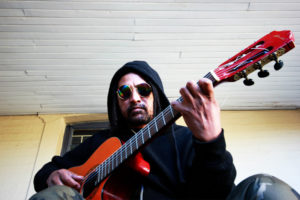
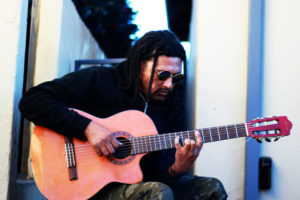
MICK RAUBENHEIMER’s Round Corners mini-interviews situate artists outside their given media, whilst peeking into their various worlds. He chats to elegantly dangerous singer-songwriter and all-round lovely peoples Les Javan.
When did you first identify as a creative artist?
As a child, between three and six years, I used to love listening to the wind blowing through trees – both leaved and leafless. Also the sound the wind made waving through the grass and around every corner of every shack in the informal settlement where I spent the first six years of my life. Every sound that happened in that corner of the world next to the bridge on the border of Bellville and Bellville South played into all sorts of pictures and films when I closed my eyes, especially in bed at night. That’s how I used to fall asleep, and still do at times.
I started singing along in church and, eventually, between the ages of four and six, started learning the early church music – both spiritual and secular – and began listening to local musicians playing music from rural to jazz and pop. Between the ages of six and 17 I studied classical music, while doing live shows and the club scene. Throughout my career I studied various musical styles like blues, jazz, country, rock, metal and mixing synth guitar with world music. While this eclectic education was great, and helped my career take shape, it is the grounding I have in indigenous/traditional music, and its modern interpretations with its various colours and flavours, that has most deeply informed me musically. Accompanying this is the art of storytelling I picked up between living in the country on farms, small dorpies, and the big city. The combination of all this and some other factors is key to the way I express myself musically.
Outside of your medium, what branch of art most stimulates you?
The medium of film captivated me as a child because this is how I hear the music I compose – with pictures/visually. When I write a song, I see the whole story playing out in my mind and hear the complete orchestral arrangement down to every detail, especially the emotional aspects. I very seldom change the story I see and just write down everything I see. Sometimes when I write for stage, TV, or film – even just a single song – I do a second take and edit the story to give it a different outcome, or to add more value to the score.
https://www.youtube.com/watch?v=7bC9ag7vSOw
Which artist/s in said discipline have significantly inspired you, and why?
A great many directors, producers and actors have inspired me across different genres. The art of the soundtrack has always fascinated me, and became part of the driving force behind me studying music. I wanted to make the films I see when I listen to my music. People like John Williams, Ennio Morricone, Hans Zimmer, James Newton Howard, James Horner, Trevor Rabin, Trevor Jones, Howard Shore, Henry Mancini, and many other great composers, have all inspired me in the modern context.
What, to you, is art’s most important function?
Art can be seen as a tool to express what we feel inside about the outside world. It therefore has the ability to communicate. Art is not time bound, has no borders, and respects all cultures and beliefs. It is the most powerful tool to teach with. Art is a way of life.
Local creatives that currently excite you?
Musicians/composers/songwriters like Kesivan Naidoo, Kyle Shepherd, Ramon Alexander, Ronan Skillen, Chris Letcher, Mark Fransman, Hilton Schilder, Mac Mackenzie, Ernestine Deane, Cama Gwin and Black Pearl.
Writers: Michael Schmidt, Riaan Malan, Heinrich Bomke, Ricardo Arendse.
Visual Artists: Alvin Schroeder, Wayne Barker.
What specific work – be it in literature, music, or visual art – do you return to again and again, and why?
I like to be with nature and experience the sounds within what we call silence. It is how my journey started. It’s the place where I first experienced me being alive and realising my own purpose of being at one with it all. The same ‘one’ that religion refers to as God.
Any current project you’re unveiling/wrapping up?
Currently (March 2017 – May 2018) I am working on various projects ranging from studio albums to music for stage, TV and film. I am finalizing the music to a story I wrote called Johannes Kontant, for which Ricardo Arendse wrote the stage script and dialogue. This is all in preparation for a film we will be doing. The story will be based on my life as an artist growing through apartheid and experiencing post-apartheid South Africa as a musician, composer and songwriter. I am also finalising my second instrumental album Echoes from Eridu (part one – Journey) – a project I started in 2004. The music was composed during my travels through Africa, Eastern Europe and Scandinavia. One of the pieces, Song for Nephtys, featured in the 2009 soundtrack I did for the film Long Street by Revel Fox. The other project is a two-part Afrikaans album. I have always experimented with Afrikaans music – from the early days with my band Atmosphere in the late 1980’s, to Gramadoelas in the 1990’s, through to my current work. I’m also very excited about the soundtrack I am currently working on – it’s for a great film.
WS