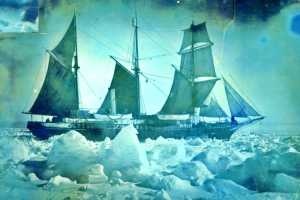
 National Geographic and partners will collaborate on an epic documentary event detailing the successful search and discovery of one of the great lost shipwrecks of history — Sir Ernest Shackleton’s Endurance. The production is set to premiere in the later half of 2022 as part of Nat Geo’s Explorer series.
Organised by the Falklands Maritime Heritage Trust, the expedition to locate the shipwreck, which has for over a century remained inaccessible and undiscovered, set off from Cape Town on 5 February 2022. It was bound for the Weddell Sea, off the coast of Antarctica where the Endurance sank in 1915.
The expedition was led by polar geographer Dr. John Shears with marine archaeologist Mensun Bound as Director of Exploration. With them, on board the South African icebreaker Agulhas II, was a crew of scientists and archaeologists alongside a team of highly experienced extreme environment filmmakers, who documented the events in real-time leading up to the historic discovery.

Provide significant insights
It took 10 days for the crew to reach the search area after navigating tricky terrain and icy waters. After overcoming technical challenges and conducting multiple survey sweeps, the wreck was found 100 years after Shackleton’s death, at a depth of 3008 meters in the Weddell Sea. The wreck was found within the search area defined by the expedition team before its departure from Cape Town and approximately four miles south of the position originally recorded by Captain Worsley, using submersibles called Saab Sabretooths, equipped with 4k cameras and lighting arrays.
The wreck appears to be well preserved due to the lack of wood-eating microbes in the Weddell Sea. The team is still on location, studying the wreck and documenting their findings. They are set to begin their return voyage back to Cape Town sometime later in March 2022. The wreck will remain untouched and without any artifacts removed, where it has lain for more than a century — but the results of the discovery will provide significant insights into Ernest Shackleton’s Imperial Trans-Antarctic expedition and offer an incredible opportunity to bring the stories of Shackleton to new generations.

The story of Shackleton and the Endurance
The Endurance left South Georgia for Antarctica on 5 December 1914, carrying Shackleton and 27 other men with the goal of reaching the South Pole and ultimately crossing the continent via an overland trek.
However, when nearing Antarctica, the ship became trapped in pack ice, and the crew was forced to spend the winter in the frozen landscape.
After being stuck in the ice for some ten months, Endurance finally succumbed to the pressure of the pack ice and sank. Following the ship’s sinking, the crew was forced to make their way by sea to uninhabited Elephant Island before Shackleton and five men set off in a lifeboat on an epic journey to seek help from a whaling station in South Georgia, more than 800 miles away.
After several attempts, Shackleton eventually made it back to Elephant Island to rescue his crew and, miraculously, all of the men under his command in the Weddell Sea survived two years in the wilds of Antarctica, making it one of history’s great stories of human survival. Shackleton himself died of a heart attack on in 1922, aged 47.
The National Geographic Society has a long history with Ernest Shackleton, who in 1910 received the Society’s Hubbard Medal — the organisation’s highest honor — for his Antarctic exploration.
What: Sir Ernest Shackleton’s Endurance and Nat Geo
WS