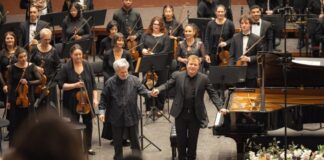
SYMPHONY CONCERT REVIEW: ENIGMATIC ELGAR. On Thursday 30 January 2025. At the Cape Town City Hall. CPO Conducted by Bernhard Gueller. Soloist: Ariane Haering (Piano). ALBERT COMBRINK reviews.
Grieg’s Lyric Suite, Op. 54
The name Edvard Hagerup Grieg is virtually synonymous with Norwegian music. Considered one of the leading composers of the Romantic Era, his music is now standard classical repertoire, the world over. Mention of “Peer Gynt” or the A Minor Piano Concerto, and one thinks of sweeping melodies, lush orchestrations, and atmospheric depictions of both the landscapes and folklore of Norway. Pianists and audiences are forever grateful for the 66 “Lyriske Stykker” (Lyric Pieces) published in ten volumes, from 1867 (Op.12), to 1901 (Op.71).
These melodic gems range from modest student pieces to virtuosic concert-pieces, and all have in common a desire to explore Norwegian folklore in as accessible and colourful a pianistic style as possible. The “Lyric Suite” Op.54 is an orchestration of a selection of Book V: a first orchestration was made by Austro-Hungarian conductor Anton Seidl, and later by Grieg himself, who had obtained the score with the help of Liszt’s granddaughter. Seidl had worked with Wagner, and perhaps that encouraged a heavier orchestration, and Grieg reworked it to create a version, much lighter, more subtle, and altogether more folkloristic in approach. Grieg also cut one number, “Bell-Ringing”, from the Seidl suite.
String playing at the outset was not super-confident, but proceedings soon settled into a tender and lyric “Shepherd Boy”. The “Norwegian Peasant Dance” was a slightly muted affair – perhaps a memory of a dance rather than a depiction of an actual event – but the approach suited the “Notturno” much better. Twittering birds were captured more successfully in the solo woodwinds than some of the strings, but the movement left a smile on the face. The “March of the Trolls” was colourful without being a cliché and the tricky rhythmical interludes were well-caught.
Mozart: Piano Concerto, No. 20 in D minor, K. 466
Austrian pianist Ariane Haering brought us one of Mozart’s most darkly dramatic and inspired works. A pianist with a formidable resumé – Prizes at Lausanne Conservatory, the Swiss Youth Music Competition and the Clara Haskill Competition to name but a few – one can see why Haering is in such demand from the Salzburg Festival to the American orchestras to concert-halls in the far East. She is co-founder of the “Alban Berg Ensemble Wien”, a septet with residence in the prestigious Musikverein in Vienna, which recorded its first CD for Deutsche Grammophon in 2020.
Hearing brought this vast chamber music experience to the table in a taught, crips and tightly woven-ensemble-concept of one of Mozart’s most dramatic pieces. Of his 27 concertos, only two were written in the minor key and this work, the D Minor K. 466 was virtually the only Mozart Concerto to survive in the repertoire into the Romantic era, where it was a favourite of pianists such as Beethoven, Hummel, Mendelssohn, Brahms and of course, Clara Schumann – all who performed the work to acclaim.
Mozart completed the work in a rush, the night before its first performance, with the ink still literally wet on the pages of the orchestral musicians, as they went into a concert of a world premiere performance, without even having had a full run-through of the work. Mozart did not write down any of his cadenzas, as he would have improvised them and had little hope that other pianists would need them in published form, leading to a number of choices for modern pianists. Haering played the Cadenzas by Clara Schumann, who was, by her own account, influenced by the Cadenzas by Brahms that she knew so well and performed often. Haering kept the dynamic range within “classical scope” and the cadenzas – while a touch overgrown with double octave-melodies and such – stayed within classical expectations of volume and scope.
Haering took control of the concerto from her first entry, with crisp and clear articulation and lyrical but crystal clear ornaments and “turns”. There were no big surprises past the rarely-heard cadenzas and perhaps that the “Mozart” effect – as concert-works they do not have the same barnstorming effect on the audience as a Russian warhorse, and hence, audiences are not always aware of the high level of skill they are observing. Haering played a beautiful D Minor Concerto. Perhaps, between the pianist and the orchestra, some more D Minor Darkness could have been explored.
Elgar: Enigma Variations
Naming the concert “Enigmatic Elgar” places the focus of the evening squarely on the “Variations on an Original Theme for Orchestra, Enigma” by Edward Elgar, and it was, indeed, the highlight of the evening. Principal guest conductor of the CPO Bernhard Gueller brings credentials as a seasoned symphonist, and the CPO has been in superb shape this season, so there was much to look forward to. The work itself is laid and overlaid with mystery, history, affection, incomprehension, and a plethora of performing styles, so there is really very little to predict exactly what kind of performance one is going to get.
Essentially, it is a suite in 15 movements: a simple theme, with 14 variations, of which the 9th, “Nimrod”, is deservedly the most famous and often performed as an independent extract. The theme itself was the result of a lucky accident: Alice (Mrs Elgar) was cooking in the kitchen while “Edu” (Edward himself) was improvising idly on the piano in the lounge. She heard something she liked and told him it held promise, and he promptly wrote it down in a notebook for later use. He decided to dedicate a variation each to a friend of his, the result being a 30-minute work with 15 movements, most of which are played with a break in between.
Gueller and the CPO presented each variation with a distinct focus and clear musical aim, making this performance feel concise and less episodic than I recall from other performances. The opening theme was infinitely tender, but not sentimental, and the hints of “Nimrod to come” seemed welcome foreshadowing rather than lack of inspiration. The “Perky Pianist” showed off the first of many exquisite woodwind passages.
The scampering violins of the “eccentric actor” had their work cut out for them, and Gueller did not push the tempo beyond the practical. “Ysobel” impressed with a warm viola solo from principal violist Petrus Coetzee, and rich sound from the section as a whole. “Nimrod” took its place as the equivalent of the 18th Variation in Rachmaninoff’s “Paganini Variation”, an honorary slow movement – played with depth and meaning, but stripped from its extra weight as funeral anthem – was a touching tribute to Mr Jaeger who supported Elgar through more than one darkly depressive episode. Following this with the flirtatious Dorabella might seem incongruous, but the lovely cello solo of Peter Martens and the subsequent cello chorus, seemed to put “Nimrod” into a larger narrative that propelled the work forward.
The comic interlude of the dog falling in the water gave the brass a chance to dialogue with the scampering strings and it was a lot of fun. More beautiful string solos followed in the “sensitive and sad scientist”, and the Nimrod theme was put in a less tragic spotlight this time.
The Romanza, which quotes Mendelssohn’s “Calm Sea and prosperous voyage” brought with it the unique colour of Eugene Trofimczyk playing a tympany with a coin on it, the rattle of which imitates the motor of a barge on the Thames. Hypnotic colours and perfect choice of tempo made this the most memorable movement, for me. And just like that, the work was over: the “Enigma” a bit demystified, presented simply and with full commitment from the players, showing without doubt, that this work does not belong only to English orchestras and conductors.
Next Concert:
Kirstenbosch Sunset Concert
Feb 2nd 17:30 – 19:00
Conductor Brandon Philips
Narrator: John Woodland
Symphonic storytelling from Bizet and Brahms to Johann Strauss and Verdi
Buy Tickets Here:
FRANSCHHOEK CHAMBER MUSIC FESTIVAL (Thu Feb 13, 18:00 – Sun Feb 16, 16:00): tickets.