 SYMPHONY CONCERT REVIEW: BAICH IS BACK. On Thursday, 23 January 2025. At the Cape Town City Hall. CPO Conducted by Jonathan Lo, soloist Lidia Baich (violin). ALBERT COMBRINK reviews.
Elgar: Serenade in E minor, Op. 20
Mozart: Violin Concerto No. 3 in G, K. 216
Shostakovich: Symphony No. 9 in E-flat, Op. 70
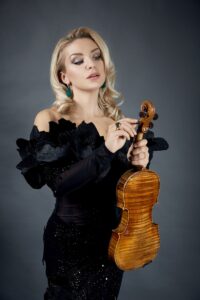
There was something surprisingly celebratory about the Cape Town Philharmonic Orchestra’s second concert of their three-concert Summer Festival. Somehow, the sum was bigger than the parts. The ingredients were promising: conductor Jonothan Lo, Music Director and Chief Conductor of the Australian Ballet, is a popular and welcome repeat-visitor to the City; St. Petersburg-born Austrian violinist Lidia Baich, while not a house-hold name in Cape Town, comes with a formidable resumé, from winning an international competition at 16 to a string of highly acclaimed CDs to her name.
The programme held promise too, but no works with the hype that perhaps a Bruckner or a Mahler symphony might evoke. We had a relatively early string work by Elgar, while not unknown, then completely underperformed in these parts. The Mozart concerto, one of 5 – while important works in their own right – does not represent the highest point in the fame of either Mozart or the genre of Violin Concertos. The programme ended with Shostakovich’s 9th Symphony, not one that carries the greatest historical weight or popularity.
But out of these parts, emerged a remarkable evening of music, which left the audience in an noticable state of heightened energy. The excited twitterings of patrons making their way down the narrow stairs afterwards, says it all: the initiated knew it would be a treat, and the sceptics were won over.

Elgar: Serenade in E minor, Op. 20
Edward Elgar was a very good violinist, and he met his future wife, Alice – a violinist – while they were in a string quartet together. A steady income-stream was presented by dinner-parties hosted by wealthy patrons, and Elgar was happy to perform and arrange lighter fare such as Strauss Waltzes and Polkas as background music, in between other more seri concerts. Alice recognised Elgar’s talent and encouraged him to compose more seriously this Serenade for Strings, a product of this time, is dedicated to her.
A recording exists of Elgar conducting this work with the London Philharmonic Orchestra in 1933. Conductor Lo took it at a slightly more leisurely pace than the composer himself, but kept a sense of movement and momentum, so that the work remained warm and affectionate without becoming sentimental.
Lo kept it simple and unaffected and the result was that we were wrapped up in an affectionate embrace from a different era, when wearing one’s emotions on the sleeve was not yet as unwelcome as it would become in the sharper glare of the Second Viennese School, for example. And precisely for that reason, it seemed terribly welcome. We needed a work that told us that – even in these turbulent news-cycles – there is love, beauty and warmth in the world and that the human values we hold dear, still has a place in society.
The slow movement was breath-taking, evoking the kind of pathos usually reserved for a Barber “Adagio” or even Elgar’s own “Nimrod”. A moment to remember for years to come. Exquisite solo-work and leadership from Deputy Concertmaster Maretha Uys made for a very special musical experience.
Mozart: Violin Concerto No. 3 in G, K. 216
Many conductors are very “prominent” on stage, but what stood out about Lo in the Mozart, is that one could easily forget that he was there, as he was not standing outside of the experience, ready to impose his will from the outside, but rather functioned like a member of the orchestra: still an integral part of the process of bringing the work to life. The 5 Mozart concertos are not the most virtuosic works – in the sense of their “flash-value”. All written in one year when Mozart was 19, it is worth noting that 26 of the 27 Piano Concertos were still to be written. Why was the genre not important enough for Mozart to return to? Why such a discrepancy in numbers? But it is a welcome reminder that Mozart was both a world-class virtuoso on the Piano as well as the Violin.
The Third Concerto is delicately scored, with transparent woodwind writing, and the wind players were in great form from the beginning. The horn parts are also cruelly exposed and sadly there is nowhere to hide when one of the pearls falls off the string. The two oboes make themselves known in the outer movements, but in the central “Adagio”, the two flutes carry the lion’s share of the poetic content, and carry, they did. The beautiful support allowed soloist Baich to play with an exquisite, pure and “vocal” tone. Her sound was never pushed, and Lo and the CPO never covered her once, while also never sounding anemic. The sprightly last movement danced along in an elegant triple meter, and the Gavotte interpolation seemed to fall out of the “Rondeau”, mid-flight – providing variety without disrupting the overall flow.
The delicate and refined ending is somehow not designed to elicit the great thunderous applause one gets after a big Russian concerto, which is always a pity, as Baich and the orchestra gave us as beautiful a Mozart Third Concert as one could hope to hear.
Shostakovich: Symphony No. 9 in E-flat, Op. 70
I enjoy it when Lo takes to the microphone, here giving a 2 minute introduction to the work, with better sound-equipment than last week. He summed up this fun but enigmatic work with a quote from Shostakovich: “It is our task to rejoice”.
“Rejoicing” is definitely not the term that comes to mind when considering Shostakovich. The Russians had just defeated the Germans at the end of World War II and everybody was expecting a big choral “Ode to Joy” a la Beethoven, to laud the “great leader and teacher” Stalin. Instead, Shostakovich gave them a terse, compact, but unique work that was described by a contemporary critic as “Old Man Haydn and an American Soldier dressed up as Charlie Chaplin” and derided for its “comical farce and grimace”. This larger older brother of Prokofiev’s “Classical Symphony”, shot from the starting blocks with verve and humour. Yes. Generous and genuine humour. The sardonic trombone seems determined to push to a cadence and keep the troops in line, but the scattering strings and chirping woodwinds just won’t let him. Lo managed to let the humour shine through without becoming caricature or self-conscious.
The symphony was a showpiece for the orchestra. Solos come from everywhere – principal Trumpet to Concert Master. Numerous piccolo solos were confidently dashed off by Louisa Theart. Principal flautist Gabriele von Dürckheim took the breath away with a pianissimo solo that got softer and softer, yet remained in tune and the tone clearly focused. Audience members around me were literally gasping as the flute got softer and softer and then even softer, and yet perfectly audible and perfectly in tune.
Principal clarinettist Féroll-Jon Davids shone in the first slow movement with fluid and tender playing. Special applause went to sub principal bassoon Arno Steyn for exquisite playing both in the slow cadenza-like solos and in the push back into the fast finale. Lo gives the impression of not conducting the solos- or at least not being a control-freak about them, thus allowing the natural musicianship of the musicians to shine through. Whether that’s how he actually does it, or not, the results were a delight.
While the Symphony is neither ostensibly “about” the war, nor feelings of heroism or personal suffering associated with loss or victory, there is nonetheless some “Luftwaffe” music, where the woodwinds shriek and crackle like bullets shot at, and from, a deadly, mechanical, airborne menace. These moments lifted the performance into a very special emotional space which left the audience exhilarated.
Many Shostakovich sceptics were converted and audience-members left the concert-hall “strangely elated”. There was absolutely “something surprisingly celebratory” at City Hall tonight and we were fortunate enough to experience it.
The Symphony Season continues on 30 January at 7.30pm with “Enigmatic Elgar” – Bernhard Gueller conducts, with Ariane Haering on piano.
Grieg: Lyric Suite, Op. 54
Mozart: Piano Concerto, No. 20 in D minor, K. 466
Elgar: Enigma Variations
What: CPO concert review – Conductor Jonathan Lo, soloist violinist Lidia Baich
Book CPO concert tickets: Here
Book dress rehearsal tickets: Here
WS