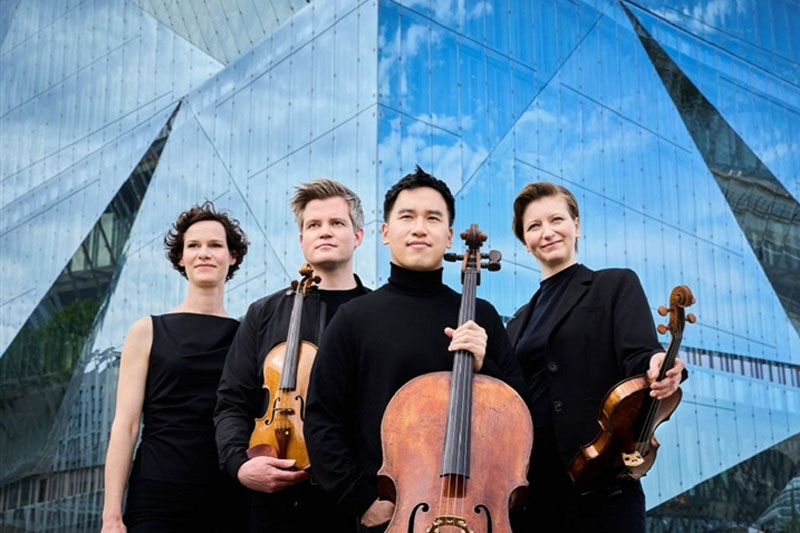
CAPE TOWN CONCERT SERIES – NOTOS QUARTET. On Saturday, 25 January, 2025. At the Baxter Concert Hall. Piano Quartets by Mozart, Walton and Shumann. ALBERT COMBRINK reviews.
When thinking about music competitions, one tends to notice those for the solo instruments: piano, violin or perhaps even singing, with global Lieder and opera competitions becoming commonplace. But chamber music has also had its own competitive circuit for decades. The Cape Town Concert Series hosted the Notos Quartet – piano, violin, viola and cello – a Berlin based ensemble with quite a few international competition prizes under their belt: major prizes in London’s ‘Parkhouse Award’, Holland’s ‘Charles-Hennen-Concours’, the Premio Vottorio Gui and the Osaka International Chamber Music Competition, led to the 1st prize at the 2016 Schoenfeld International String Competition, in Harbin, China. Violinist Sindri Lederer, violist Andrea Burger, cellist Benjamin Lai and pianist Antonia Köster presented a programme of three Piano Quartets: Mozart, Walton and Schumann.
Ranging from the well-known to the almost completely unknown, the programme tested the range and versatility of the ensemble, as well as the genre itself.
Recent debuts include performances at London’s Wigmore Hall, the Concertgebouw Amsterdam, and festival appearances at Schwetzingen, Rheingau, Würzberg, Mecklenburg-Vorpommern and Usedom.
Range of colours
When asked in an interview, “What do you love most about the ensemble of a piano quartet?”, their response was: “We are most fascinated by the sheer range of colours and versatility that each instrumental voice brings to the group. We love that once you’ve found the right balance between the string trio and the piano to create a unique quartet sound, the range spans everything from intimate moments to symphonic grandeur. You can even perform whole symphonies with a piano quartet and never lose the intimacy of a chamber music formation.”
Intimacy we certainly had, symphonic grandeur perhaps in smaller dosage, but in a well-contained range. The sound was always balanced, and the piano never drowned the strings – a real danger in chamber music.
Many conversational corners
The ensemble was always superbly together, and many conversational corners, pauses for emphasis or humorous passing of material from player to player, went off without a hitch. Polish and refinement were on display, and one can feel that perhaps here and there, the ensemble can afford to let rip a bit more.
Wolgang Amadeus Mozart: Piano Quartet No. 2 in E Flat Major K 493
Mozart wrote his second Quartet for piano, violin, viola and cello in 1786. The 30-year-old was at the height of his abilities as a performer: this is the era of the great Piano Concertos, most of which he composed for his own performance. The piano-part of this quartet is of concerto-like proportions. When the trio started, the piano took the lead, and I was worried that the strings would be left out in the wind. But all fears were cast aside when the violin took the second theme: this is a highly thought-out and carefully managed interpretation which leaves nothing to chance.
Mozart wrote the First Quartet on commission (a set of three was ordered by Hofmeister, the publisher) but the work was so unpopular with audiences that no-one bought it, and Hofmeister then hurriedly bought Mozart out of the remainder of the commission. Mozart, however, wrote this second work for himself and his own pleasure anyway, possibly explaining the virtuosity of the part. While the balance of instruments was expertly handled, I wondered if I would not have wanted a bit more extrovert playing from the pianist, in particular. The string playing was tender and sweet and the violin solos sang with a beautiful and intimate tone. Especially the stillness of the slow movement seemed to foreshadow moments in Beethoven, such as the “Ghost Trio” where the audience was so drawn in that one could hear a pin drop. In the last movement, the piano’s concerto-like flourishes were quite contained, but what we lost on the swings of passion, we gained on the roundabouts of classical refinement.
William Walton: Piano Quartet in D Minor
A work probably never heard in Cape Town before, is the exceptionally difficult Piano Quartet by Willaim Walton – a shockingly precocious work for a 16-year old that was almost “lost in the mail” when Walton posted the only existing copy of the manuscript from Italy back home to England. Luckily for us it resurfaced, allowing for two sets of revisions, making it a colourful and energetic contribution to the genre.
Playing and writing, both remarkable for the contained excitement and bursts of energetic and extremely difficult writing, was thrilling from first to last. Only in the “Andante Tranquilo” did my mind wander once or twice, and perhaps some more presence from the cello would have anchored the lower harmonies a bit. It is an understatement to called the pianist’s fingerwork “fleetfooted” or “nimble” – she was superb in the exceptionally demanding piano-part. The Finale was thrilling, and the sweeping melodies swept the audience to their feet for an ovation half-way through the concert.
Robert Schumann: Piano Quartet in E flat major Op. 47
In her spoken introduction to the work, the violist referred to the work as a product of Schumann’s happiness, and joy of his life with his beloved Clara. However, we do know that the picture was slightly more complex: Schumann was not only bipolar – attested by writings, well-meant diagnoses and attempted cures, a suicide attempt and an early death – possibly by his own hand – in an asylum, but he was possibly schizophrenic as well, attested to by his two wildly different “personalities” Florestan and Eusebius, with which he signed letters or compositions. Plus, he had had a huge fight with Clara while on a concert-tour, and had returned to Leipzig alone, to mope, drink too much, and play chamber music to himself, resulting in what is known as “the Year of Chamber Music” in which he wrote his greatest works in the genre.
A good Schumann performance – to my mind – would reflect all these elements. We had a lot of Esusebius – the tender and reflective personality – while the fast music was contained and played with excellence and virtuosity. The model for the Scherzo could be Mendelssohn, whose scattering “Midsummer Night’s Deam” and “Queen Mab” associations were unleashed on the world 2 decades before. Both in the first movement, when the piano scurries up the keyboard and down again in excited scales, and in the hustle-bustle of the Scherzo, I would have liked a bit more of the dark energy and fire.
The string playing in the slow movement was exceptional and the fleetfooted finale brought proceedings to an exciting close.
Encore – Fritz Kreisler: Liebesleid
A sweet, tender and intimate quartet arrangement of this audience-favourite rounded off a delightful morning which thrilled the listeners. Exceptionally polished playing, superb intonation, unfailing ensemble and balance, provided a satisfying concert of familiar and unfamiliar material.
Let’s hope we see this group in Cape Town again. Until then, their interesting and award-winning CD’s will have to suffice.
The Cape Town Concert Series 70th Anniversary Season continues on 15 February 2025 at 11.am at the Baxter Concert Hall with the Spina and Benignetti Piano Duo.
About the programme
Franck: Prélude, Fugue et Variation op. 18 – transcription for piano four hands by A. M. Decaux
Liszt: Les Préludes – transcription for piano four hands
Wagner: Tannhäuser Ouverture – transcription by Hans von Bülow
Ravel: Valses Nobles et Sentimentales – transcription by Lucien Garban
Ravel: La Valse – transcription by Lucien Garban
Read more about the artists: https://www.ctconcerts.co.za/concert/spina-and-benignetti-piano-duo/
Book tickets here.
What: Cape Town Concert Series Notos Quartet review
WS