SYMPHONY CONCERT. 2 May, 2024. At The Cape Town City Hall. CPO conducted by Bernhard Gueller, soloist Peter Martens. Liadov: Eight Russian Folksongs, Op. 58; Dvorak: Cello Concerto in B minor, Op. 105; Sibelius: Symphony No 1 in E minor, Op. 39. DEON IRISH reviews.
The last concert of the CPO’s Autumn Season included a rather dramatic last-minute change of concerto, due to the unavailability of the intended soloist. The orchestra’s principal cellist, Peter Martens, stood in at literally 24 hours’ notice and he, and the orchestra, had accordingly only one rehearsal of the chosen work before the concert.
It tells one a great deal about this fine musician that, having delivered a rewarding account of a taxing work, he matter-of-factly resumed his seat in the cello section for the post-interval Sibelius symphony. It merits the doffing of a hat.
I have not listened to these Liadov folksongs for some time, and in consequence this performance was a delightful treat. The eight short settings are richly melodic with neat orchestration, frequently of great delicacy, and provide an ideal non-challenging listening experience.
Carefully nurtured by Gueller
The performance was carefully nurtured by Gueller and the orchestra rose to the occasion with some fine cohesive playing, peppered with numerous brief but telling instrumental solos.
So, the opening Chant Religieux featured a lovely cor anglais solo and an even more memorable bassoon solo, dying away to the barest whisper. The pizzicato strings in the succeeding Chant de Noël sparkled in festive unison and was immediately contrasted with the soulful solo cello (a nice opportunity for sub-principal Eddie McLean) of the Complainte.
I thought the piccolo and divisi flutes in the Scherzo quite delightful, with Gueller maintaining a neatly precise pizzicato accompaniment; and then we were into the chirruping and chirping of the Légende des oiseaux, which rather pertinently demonstrated whence Ravel derived his orchestration of the “Ballet of the Unhatched Chicks” in “Pictures at an Exhibition”.
The serene Berceuse, with its muted strings, provided a serene idyll before we were back into the perky world of pizzicato strings and piccolo in the Rondo, the writing suggesting the finale of Allan Stephenson’s Piccolo Concerto – except for the differing tambourine element. Finally, the exuberant Choeur Dansé, a village dance full of lively gaiety and even a touch of grandeur!
We then heard Dvorak’s matchless cello concerto, which is surely the concerto written for this instrument? Martens had, as it happens, performed the work with the Eastern Cape Philharmonic just the previous Sunday afternoon (in a programme conducted by Leon Bosch that included the premiere of David Earl’s concerto for double bass). Still, even if the work was under his fingers, it was some time since the CPO had performed it and that made it a tough ask on one rehearsal.

Lovely moments
It is to the credit of both Gueller and the orchestra that there was little to cavil at in a performance that showed no overt sign of lack of preparation. The long ritornello (with its prominent horn solo) was warmly embracing and led to an introductory cello statement that was as musically assertive as it was technically assured – the chains of ascending trills being delivered at a pretty brisk tempo.
There were some lovely moments in the Development, with the variation with flute soloist particularly ear-catching. The cadenza was a fine display of assured technique, sequential broken arpeggios, jittery sixths and thirds and soaring octaves presenting seemingly little difficulty. The trumpets’ fanfares in the final measures were suitably invigorating.
The adagio was a beautifully lyrical cantilena, with some splendid solo clarinet contributions along the way. The central outburst had the vigour of aroused emotion rather than of frenetic action, which is just as it should be; and then we were back into dream-mode, with a lovely account of the horn trio in the concluding section.
The finale – the opening little march of which always seems perfectly proportioned for the Seven Dwarfs – was a delightful romp, with the perkiness of the march writing being offset by the cello’s splendidly yearning song.
There was a delicious moment when the Peter’s solo cello sequence of ornamented figures in the meno mosso episode gave way to orchestra leader and brother Philip’s solo violin in the following a tempo. There was another wonderful moment: when the cello – starting from its high B, began the ineffably regretful descent: the minimal accompaniment and merest whisper of timpani strokes sounding for all the world like something Richard Strauss might have intended for his Feldmarschallin. Bravo!
Magisterial reading
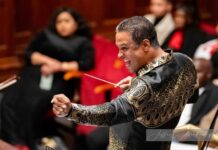
After interval, Gueller gave us a magisterial reading of the Sibelius First Symphony. This is a work the orchestra does perform fairly frequently and which had the benefit of full rehearsal, too. Playing was assured, cohesive and beautifully responsive to Gueller’s always insightful direction. He rarely adopts the showman stance – perhaps occasionally allowing himself the indulgence of a grand gesture – concentrating rather on ensuring crisp entries, taut ensemble, and refined balance.
He knows this orchestra and this hall equally well; and there are few conductors who can judge balances in the venue better than he does. His dynamic variations and control are always impressive – not merely reproducing that which is in the score, but translating it to the venue. In the result, things generally sound remarkably attuned to the hall, which gives an individuality of experience far removed from most recordings.
In the hands of one such as this, directing an orchestra so willing to give, live orchestral music is very hard to beat.
What: CPO Concert review soloist Peter Martens
Reviewer: Deon Irish
WS