CONCERT REVIEW: Cape Town Concert Series presents: Erik Dippenaar: Baroque Keys. At the Baxter Concert Hall, Cape Town. On 14 February, 2026. ALBERT COMBRINK reviews.
Having just celebrated 70 years of music making, the Cape Town Concert Series places the spotlight on its iconic Steinway Grand Piano as it celebrates 65 years of musical excellence in partnership with the specialist technical care of Ian Burgess-Simpson Pianos. The International Piano Series will present a vibrant lineup of solo piano and chamber music, with leading local and international artists. Today’s recital framed this entire season in its historical context by presenting an entire recital of music dedicated to forerunners of the modern piano.
To all intents and purposes, Erik Dippenaar has become “Mr Baroque” in Cape Town, having established various concert series, festivals, outreach- and exchange programmes and more, creating a vibrant Baroque scene in the city. That he now lives in Norway, is our loss, but that he feels happy enough to return to perform here, is our great fortune. Dippenaar is a product of both Stellenbosch University and the London Royal College of Music where his studies in harpsichord, fortepiano and organ resulted in an MMUS degree and an Artist Diploma in Performance.
He made his mark
Even before leaving South Africa the first time, he had made his mark, winning, amongst others: ABSA National Youth Music Competition (2000), UNISA National Organ Competition (2001), Mabel Quick Bursary Competition (2001), ATKV Musiq Competition (2002), the organ category of Distell Music Competition (2002) and the Unisa Overseas Bursary competition (2003).
Erik is currently Artistic Director of the Cape Town Baroque Orchestra, Artistic Director of the annual Cape Town Baroque Festival, and an adjunct lecturer in organ and harpsichord performance, as well as Western music history and historical performance practice, at the University of Cape Town (UCT). His conducting highlights include the first South African period performance of Handel’s Messiah in 2013 (a reconstruction of the 1742 Dublin performance), as well as Cape Town Opera’s first production to use a period instrument orchestra: Monteverdi’s L’Orfeo in 2016.
Erik has recently been awarded a PhD in music by UCT, with a dissertation focusing on the role historical domestic keyboard instruments played in the colonisation process in Southern Africa.
Enough to say, we are in good hands. Dippenaar introduced the works and instruments from the podium, but his informed, yet down-to-earth, manner turned the morning into a delightful journey through the pages of history, rather than a lecture recital with dust on the cover.
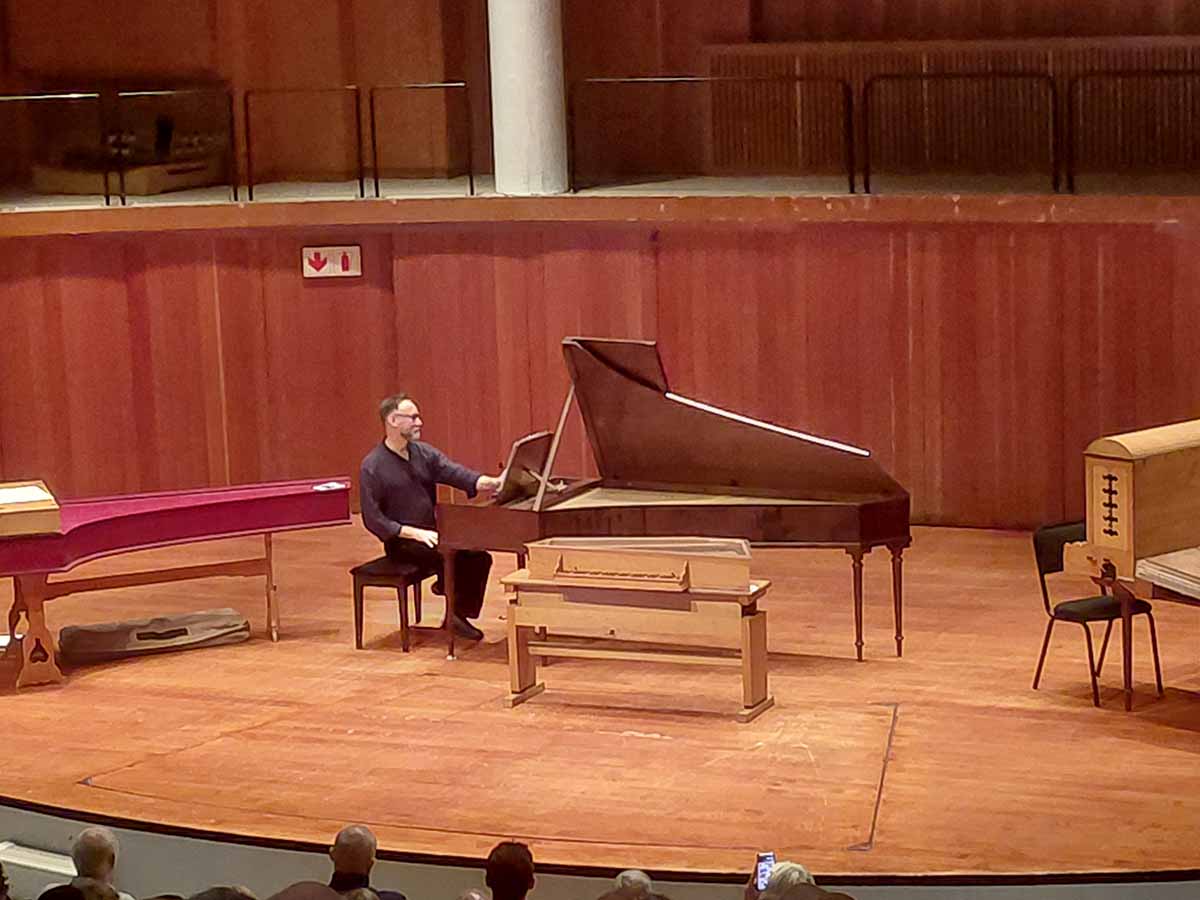
The stage was a display of various keyboard instruments – all prototypes and forerunners of the modern piano – and he moved between the instruments as the repertoire dictated. My first overall impression was an element of anticipation: What does this one sound like? How is that one played? What’s that thing on the floor? The result was over an hour of mostly unfamiliar music interspersed with a few familiar favourites, traversing more than 200 years of history, in a sight- seeing tour that was not too short and not too long.
We started on the “French” Harpsichord with a French composer: François Couperin’s “Les Barricades Mystérieuses”, a hypnotic little rondeau in Style brisé (or style luthé), where chords are broken or arpeggiated rather than played together, creating a continuous, shimmering, and intimate texture. The title remains mysterious, with theories suggesting it refers to masks, female chastity belts, or the “barricade” of the harpsichord’s own strings. The gentle opening work gave our ears time to adjust to a slower, softer aural experience than we might be used to in our own century.
William Selway Robson
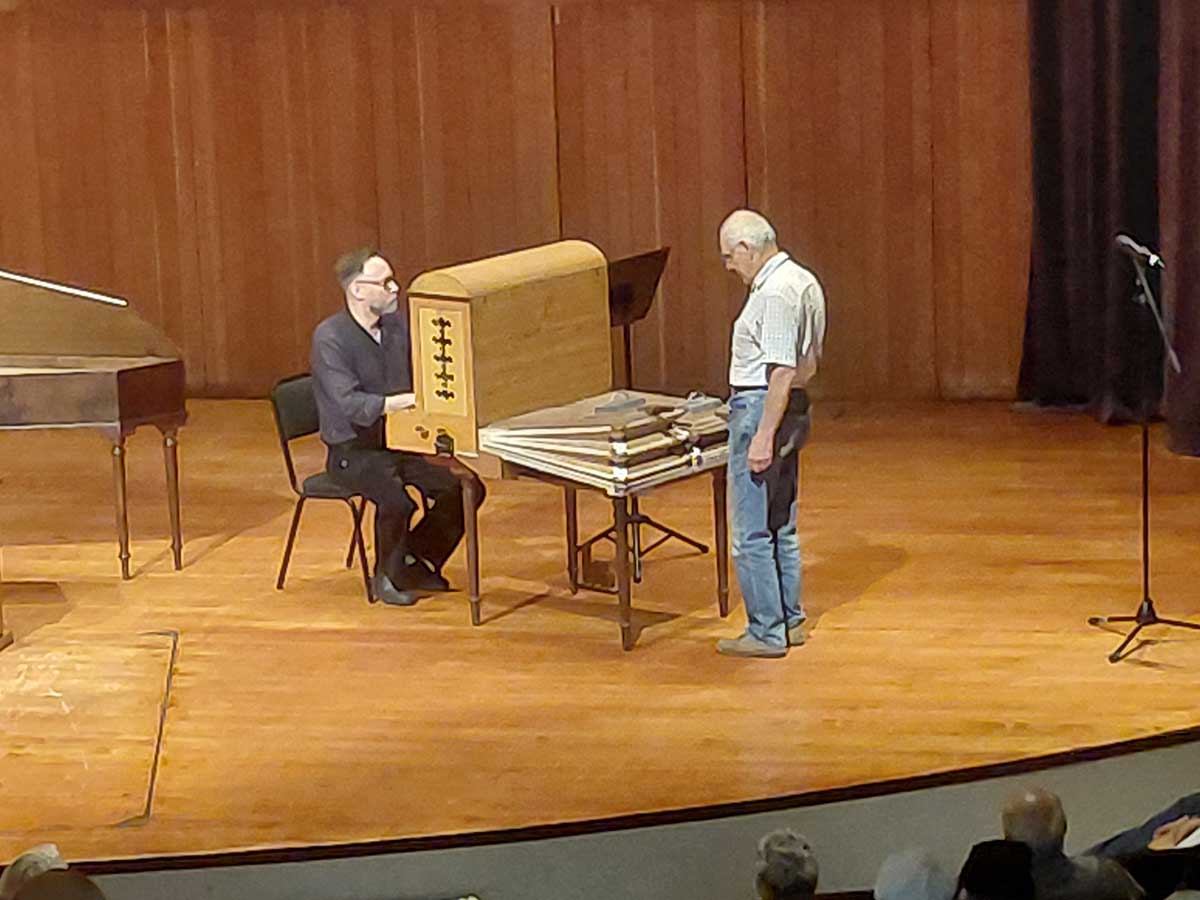
Many of the instruments on stage were built or restored in Cape Town by William Selway Robson, who was in the audience, and he joined Dippenaar on stage to work the bellows for a performance on the Regal, a small, portable Renaissance- and Baroque-era reed organ, characterized by its buzzing, nasal tone produced by brass reeds and short resonators. Popular in the 16th and 17th centuries, it was used for both sacred and secular music, often functioning as a continuo instrument (strengthening the bass register as cellos and double basses were still in their infancy, and still using softer-toned gut-strings, rather than metal, in use today.)
This kind of practical, visual, historical demonstration does more than many a paragraph in a textbook in revealing the very real odds that faced musicians of yesteryear. One could not even practice on an organ unless one had a second person there to work the bellows! Transporting these instruments? Well-nigh impossible. Hearing them 20 feet away? That’s another story…
Dippenaar played three pieces from “The Mulliner Book” (British Library Add MS 30513). It is a highly significant mid-16th-century musical commonplace book, compiled by organist Thomas Mulliner between approximately 1545 and 1570. It is a vital primary source for early Tudor keyboard, cittern, and gittern music, containing 134 compositions. In the absence of any form of copying or recording technology, ordinary citizens would write down their favourite tunes in a “commonplace book”, for later enjoyment as home entertainment.
The Octave Spinetto, a table-top pocket-piano, was perfect for a soft-spoken transcription of the famous song of courtly love, “Amarilli mia bella” by Giulio Caccini (c1545-1618). A bigger and louder Pentagonal Italian Spinet followed for a set of variations on the popular Renaissance tune, “More Palatino” by Girolamo Frescobaldi (1583–1643). By now we were ready for something lively, and the dance-inspired variations provided quick-changing, ear-tickling playing, where it was noticeable how Dippenaar’s technique came into play: imitation passages between the hands were deftly handled, with the left hand matching the virtuosity of the right, in execution of turns, trills, runs and all manner of ornamental display.
The Aria La Capricciosa and Variations in G major, BuxWV 250, is a major keyboard work (harpsichord) composed by Dieterich Buxtehude (c. 1637–1707), the renowned Danish-German Baroque composer and organist, celebrated as a master of the North German organ school. It consists of an aria followed by 32 variations, showcasing varied styles and virtuosity. It is often regarded as a precursor to Bach’s Goldberg Variations. Dippenaar played a selection of the variations. Clarity of counterpoint is easier on the harpsichord, as there are fewer distracting harmonics than on a piano, but delineating separate voices on an instrument with severely limited tonal capabilities, pushes the focus elsewhere: articulation, timing, slight rhythmic distortions etc.
Dippenaar employs Baroque agogics as one speaks a language: the theory posits that rhetorical emphasis involves not only dynamic stress but also the emphasis implied in the greater relative length of the tones to be emphasized. To do this without attracting attention to the method, is something that comes from mastery of the genre, and we were treated to an impressive display.
Two works by Handel followed: an Italian aria Lascia ch’io pianga from the opera Rinaldo arranged by William Babell (c. 1690 – 1723), an English musician, composer and prolific arranger of vocal music for harpsichord. Played on the so-called “Italian” harpsichord, we heard the bright tone of the vocal line and the violinistic flourishes added to the expressive vocal line. Handel’s “French” style was demonstrated on the “French” Harpsichord, in the Air (The Harmonius Blacksmitgh) from Suite No. 5 in E Major HWV430 (1720). Playing this work on the same harpsichord as the opening Couperin, instantly brought home Dippenaar’s point about the colour of instrument and the style of music to which it is suited.
Listening to Handel and recalling Couperin, was a brand new, but absolutely delightful connection to make. I felt like a grand professor having unlocked the mystery of “Handel’s French Style” which I had read so much about in textbooks and studied from various angles. But this format made it simple, accessible, and educational without you feeling as if you were attending a lecture for which you had not done all the required readings…
The finale was a set of 4 works from Jean-Philippe Rameau (1683-1764). Pièces de Clavecin avec une table pour les agrémens (Pieces for harpsichord with a table on how to play the ornaments) from 1736, was a delightful set of sound-poems: an elegant Allemande, a tree full of chaotic, noisy birds, a musette with a droning hurdy-gurdy and a coquettish Tambourin dance, showed why Rameau is still revered as one of the absolute masters of the genre.
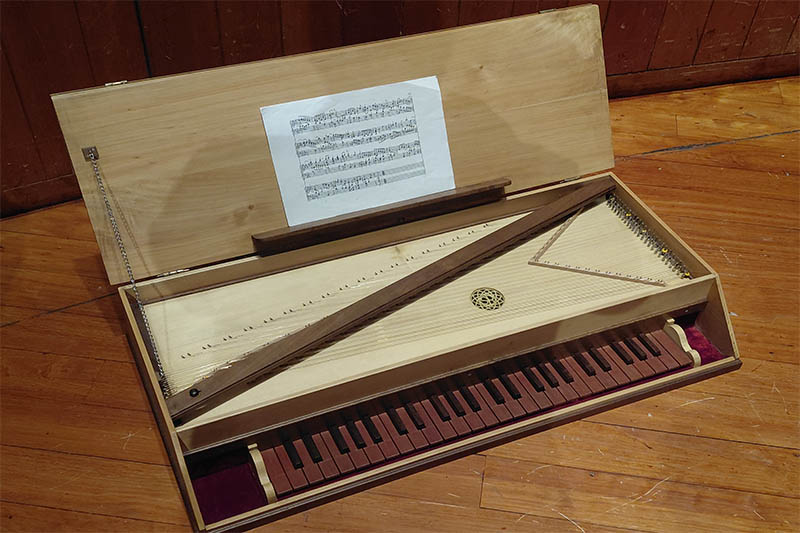
Dippenaar ended his recital on a Clavichord, with an excerpt from Bach’s “Goldberg Variations”. It was virtually inaudible. But rather than cause irritation, it created nostalgia, and even a bit of heartbreak. These instruments did not survive. They were supplanted by more modern versions, as composers and pianists required more: more volume, more notes, more people in the audience at one time, more portability, more octaves. And yet, they still survive. People want to play them, and people want to hear them. And people still want to play and hear all the exquisite music that was written for them. We have all played some Bach on a Piano, many of us have played or heard the “Harmonious Blacksmith” (more or less harmoniously played by professionals or students: it was in the ABRSM Grade 8 Exam list as recently as 2016.) And yet, to hear it in its original costume revealed something new, something fresh, something delightful.
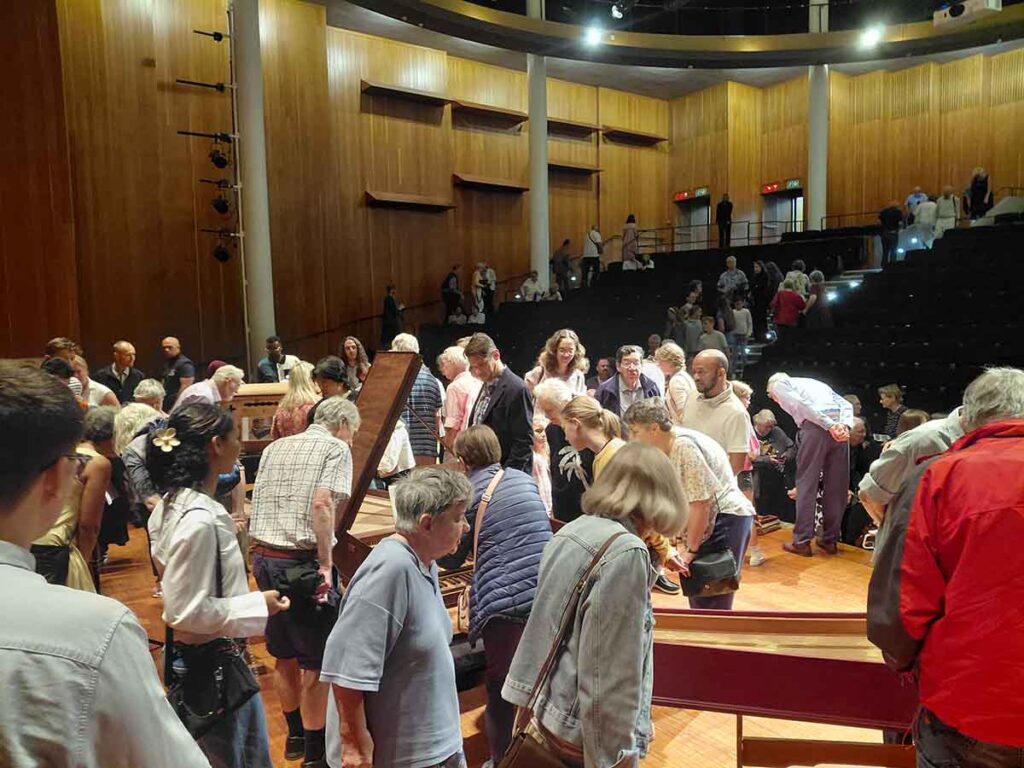
I will always remember the audience sitting forward in their seats, straining to catch a few notes of the Bach Aria. Afterwards, the audience was invited on to the stage for a closer look at the instruments, and the stage was packed with delighted audience members, some asking questions about anything from portability to notation. Some brave concertgoers even plucked a note or two to test the instrument, literally feeling history move under the fingertip.
A remarkably original, creative, and most memorable morning.
Next concert: Ludmil Angelov: Mozart, Weber, Chopin, on 14 March 2026 at 11:00. Book here.
What: Cape Town Concert Series Erik Dippenaar Baroque Keys
WS