This week’s Mining Indaba 2023 at the Cape Town International Convention Centre (CTICC) brings together innovators from across the value chain. It runs from 6 to 9 February 2023. Forming an apt backdrop to this year’s event is the work of mining and Earth artist Jeannette Unite. Her weighty PLOT: Critical Zones exhibition at Iziko South African Museum, Cape Town, is a fitting complement to deliberations at the gathering.
Unite creates installations that encourage debate around our responsibility as consumers – every one of us – and social justice. As such, she invites viewers to ponder all aspects of the industry and the process of resource extraction and utilisation.
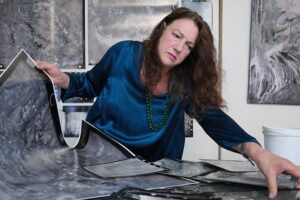
Coal, chrome, cobalt, more
She mixes detritus, oxides, metal salts and residues from extraction and industrial sites into her paints and pastels. Her “geo bar-code” artworks are infused with coal, chrome, cobalt, copper, gold, iron and platinum fines – all elements extracted from the Earth’s critical zone. Their presence reinforces the concept that consumerism, at all levels, shapes society, and highlights our role in driving the mining industry through our demand for the ingredients for manufactured comfort goods.
The installation highlights our role in driving the mining industry through our demand for the ingredients for the manufacture of goods and tools that make humans lives more comfortable.
The paint Unite makes for her ‘geo bar-code’ artworks is infused with coal, chrome, cobalt, copper, gold, iron and platinum fines – all elements extracted from the Earth’s critical zone. Their presentation reinforces the concept that consumerism, at all levels, shapes society.
In much the same way, the artist uses her published ‘mind sketchbooks’ to weigh up the enduring interconnection between geological consumerism and its aftereffects, calling for beneficiaries of extraction to be tasked with nurturing Earth care.
‘We are all complicit, even though we think we are separate. We are not separate because we drive industry,’ she says.
PLOT also investigates the history of legal rights over land and resources (water, minerals), measurement and division, ownership, licences and title deeds. And in this time of increasing environmental stress, Unite’s artwork inevitably speaks to broader sociopolitical issues. This includes the current global rush to secure mineral commodities as tensions rise due to energy crunches and fuel price hikes.
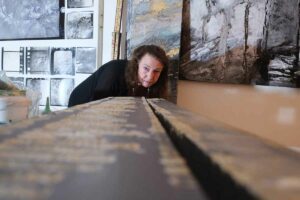
Premier natural history museum
Ultimately, she takes matter of little commercial worth and paints narratives with huge conceptual value. This is recognised by the museums she has exhibited in globally, including Iziko, which is arguably Africa’s premier natural history museum housing collections worth more than R1.8-billion, recognises the profound artistic and educational value of these pieces.
The exhibition distils decades of research into the industrial landscape of South Africa – historic, scientific, material and, most importantly, artistic. As Andrew Lamprecht and Ivor Powell comment: ‘Mining left no part of contemporary South Africa untouched. It led to wars, displacement, the decimation of populations, the calculated and often brutal destruction of sociopolitical formations and untold environmental damage, as much as it consolidated economic power and promoted industrial development. Unite’s artistic reflections on these issues do make, we believe, an important contribution to understanding where we stand today.’
The artist will soon release a new copper covered 400-page coffee table collectors’ edition book, titled Complicit Geographies. ‘My books give me an opportunity to share the insights from my on-the-ground research of hundreds of extraction sites in 32 countries. It is this background information that informs all my artworks,’ she says.
Who: Artist Jeannette Unite
What: PLOT: Critical Zones
Where: Iziko South African Museum until 31 March 2023
Web: See www.unite.co.za or www.iziko.org.za
WS