Mining and Earth artist Jeannette Unite views her work as “a point of enticement”. Part socio-political commentary and part celebratory affirmation of nature, her reverence of the wonder of the universe highlights the amazing world we live in. But while she marvels at the planet’s minerals, materials and geology, her joy is offset by the ongoing destructive gouging out of the Earth – for geology, she says, is about “life, death, life…”.
Unite’s current transdisciplinary exhibition is on view at Iziko South African Museum, Cape Town, until 31 March, 2023. Titled PLOT: Critical Zones, the showcase distils the artist’s research across more than 30 countries, and examines how Earth is owned, measured, divided, and allocated by title deeds and legal rights over land and resources.
Underpinning it all is a focus on the so-called Critical Zone that encircles Earth, the layer from above the tree tops to below ground water, where melded minerals and water create and support life.
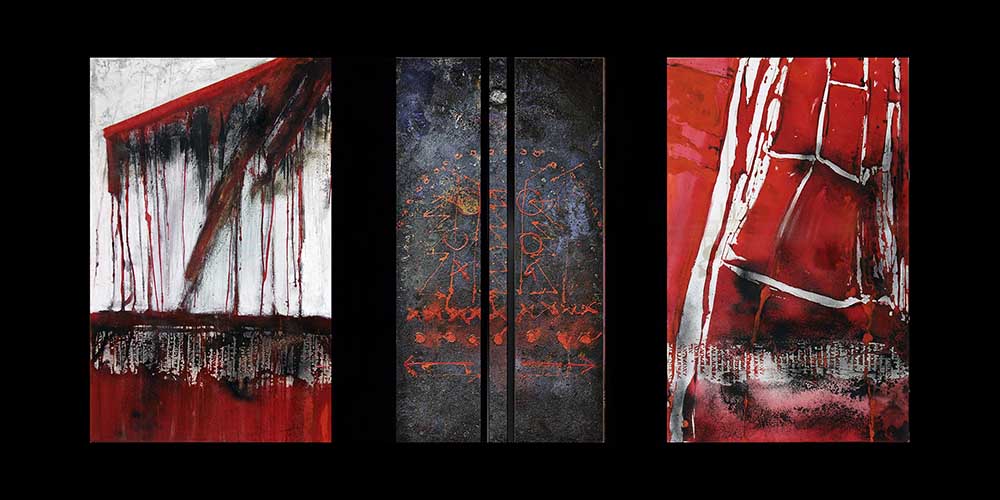
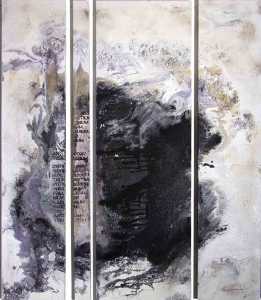
Through an installation of mostly large-scale “bar-code” paintings, Unite spotlights this imperilled environment, calling for collective Earth stewardship to safeguard the degradation of this complex natural habitat.
Oxides, metal salts, residues
Her extraordinary eco-alchemic works are created with the mined material they interrogate, using a paint box comprising of oxides, metal salts and residues harvested from extraction, heritage and industrial sites. These she combines into unique paint, pastel and glass recipes developed with the assistance of paint-chemists, a ceramicist and geo-chemist.
As such, PLOT: Critical Zones details her collection and interpretation of images and minerals from the mining industry. Her palette, organised in a distinctive periodic table, consists of jars filled with mined matter – this includes both the precious ores used in industry, as well as those from slimes dams and tailing dumps, which she gathered during travels to remote extraction areas in numerous countries.
Gold, platinum, copper, coal, cobalt, iron and chrome are among the elements in the paint ingredients that she has accumulated since the 1990s, notably these elements were all extracted from the Critical Zone.
“When I was an undergraduate, our Professor Kevin Atkinson taught us how to make our own paints with marble dust and pigments, which were economical and of high quality. When I was living on African West coast diamond mines it was a small leap to see that the titanium washed up on beaches was the white pigment in my paint tubes. I had already started collecting red iron-stained sand from the Kalahari in 1991, but this collecting became more conscious and focused as I began navigating the mining theme in the 1990s,” she explains.
“There were few contemporary artists who had worked with mining before the 1990s. The Becher’s had photographed typologies, their description of the generators and mine shaft heads; Ernest Cole had photographed mine-workers; Gerard Sekoto had painted scenes of Poverty in the Midst of Plenty; David Goldblatt had photographed mines, and Kentridge made a video of underground rock-drilling. Subsequently, it has been exciting to see how many artists have seen the value of using mine detritus, and have influenced the artwork processes of others.”
 Cross-disciplinary science and art
That the exhibition is in Iziko’s natural history museum is indicative of Unite’s synthesis of cross-disciplinary science and art. She points out that the highly naturalistic rock art in this museum is also significant.
It’s fitting then that her 7m wide high personalised Table of Elements is displayed in the Periodic Table format. “When my collections of minerals from mines became too chaotic, I realised that the grid of the Periodic Table was a brilliant system of organising all the ore and pigment powders. I refer to the periodic table shelves in my studio as my “artists paintbox”, she says.
“The paintings in the exhibition are the height of a human and of various width. These panels resonate with the “bar-codes” format – they are mineral geo-seam paintings that are all the same height, installed as a continuous lode with certain minerals dominating like copper, manganese, titanium platinum fines and gold mine dump sands.”
In Unite’s view, people need to reflect on the rarity of the materials. “I am trying to awaken consciousness – not only of the mining industry being essential to our lives, but that we drive the industry and purchase objects with built-in obsolescence, and the lack of care for manufactured goods that actually demand so much mining. It’s us who demand the mining. It’s us artists who use pigments that come from mines. We all drive the industry through the use of modern phones, flying, driving, kitchen utensils and appliances… It’s us humans, all of us – we are the end users.”
“I’m also trying to create an awareness of how beautiful this stuff is – the wonderful colours that you get from Earth – this incredible, sparkly chrome and the deep browns of the manganese, the turquoises and the ultramarines and the crazy greens you get from copper with the different reactions in paint – and I get even better reactions in the copper in glass. As artists, all our pigments come from Earth.”
“For me, my work is an ongoing epiphany,” she says. “It’s a journey. We live in the most wonder-filled world and we need to be worthy custodians of this beautiful planet.”
Who: Artist Jeannette Unite
What: PLOT Critical Zones
Where: Iziko South African Museum, Cape Town
When: Until 31 March 2023
E-mail: studio@jeannetteunite.com
Web: www.iziko.org.za, www.unite.co.za
WS