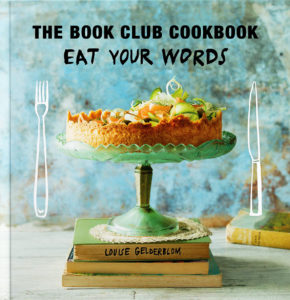
 Renowned ceramicist Louise Gelderblom is known both locally and globally for her striking, often dramatic clay works. But what is not as well known is the fact that she also a skillful cook, who brings her artist’s flair to the preparation, production and presentation of food. Plus – Louise is a voracious reader who has belonged to a book club for many years. So what does one do with all these ingredients? If you’re Louise, you create a beautiful recipe book that brings it all together – The Book Club Cookbook: Eat Your Words, published by Quivertree Publications.
WeekendSpecial spoke to Louise about the book and her work. She also shared a recipe with us (see below):
WeekendSpecial: We know many people who are in book clubs, and very often food (and wine) play a big part of the experience. What made you think of combining the experience of your book club with a book of your recipes?
Louise Gelderblom: Doing a cook book has always been a pipe dream for me, but I was hesitant to go there as I wondered if I could ever add anything truly new, useful or significant to the genre. I am a very curious home cook and very comfortable in the kitchen, and often help less confident friends with menu planning. It seems a pity to me that people do not invite their friends around because they do not know what to cook, or how to do it. This fear of the kitchen was very evident in some of my book club friends, and gradually the idea of a collection of recipes that are easy and can be prepared ahead of the time (so that you are not stuck in the kitchen doing fussy little last minute things) was born. After Googling the concept for a while, I realised that it was not something anyone has done before, and hey presto!
WS: Have you always loved cooking, or was it a gradual thing?
LG: I come from a family that loves food. Any celebration is a great food opportunity. My first memories of cooking are making elaborate mud pies under the Syringa tree in our backyard in Kimberley, as well as the industry and total focus on my grandparent’s farm in the Eastern Cape on special baking days and the days meat was processed after slaughter. My efforts in the kitchen became more focused when I became a vegetarian in a meat-loving family when I was 18, and since then it has been part of my scope of interest.
WS: The recipes are for the main part vegetarian, with some chicken and fish dishes. Why is this?
LG: I do not eat red meat. And I have sat around one to many dinner party tables with a sad take-away meal while the rest of the table are served some sort of meaty meal. I believe one should cater for the greatest common denominator and hope the recipes in this book achieve this. If you are having 16 of your best friends over and one of them is vegan, it is totally possible to serve a vegan feast to everyone …you do not even have to tell them!
WS: You speak about “noble ingredients” in your recipes – what are these? And how can we find them?
LG: Noble ingredients are mostly good, honest ingredients like olive oil, butter, fresh fresh produce, free range eggs, chicken and fish, etc. cooked or prepared in a simple, undisguised form. A humble potato is a noble ingredient: it loses its nobility when it is cooked to death or smothered in a whole lot of confusing condiments. Ingredients that are not noble? Margarine, bread that tastes like cotton wool for all the additives, artificially sweetened stuff, processed foods, and so on.
WS: Please tell us a bit about your book club – it’s been going for over two decades. What kind of books do you read? And is everybody good at cooking?
LG: We read mostly literary fiction, biographies and memoir. While we often explore the South African and African literary scene, we do read books from all over the world. We always eat very well, despite the fact that a couple of members are not confident in the kitchen and stress a lot when it is their turn to host the group. It is this type of cook that I kept top of mind when I compiled Eat Your Words.
WS: You are, in your real life, an internationally acclaimed ceramicist. What do you think are the links, if any, between producing beautiful ceramics and producing beautiful food? Is it a “zen” thing?
LG: I’m hesitant to call them “zen” or “mindful” activities, because the concept of mindfulness is getting a bit tired by now, but I think that, with both of these activities as with so many others, the quality of the end result is almost always reflected by the level of attention paid to the production thereof. With both cooking and ceramics you start with good quality materials/ingredients, you pay careful attention to how you work with them/process them, and you end with a beautiful dish or artwork. (Well, most of the time!)

WS: Tell us about producing the book – choosing the recipes, trying them out. Firstly, how did you decide which recipes made the cut? And secondly, were many of your friends and family lucky guinea pigs?
LG: Compiling a cookbook was an entirely new experience for me. Initially I collated and collected recipes in a frantic, haphazard manner, but soon realised that this wouldn’t get me anywhere, so I started again and tried to imagine the type of food and structure of a meal shared by like-minded people: snacks, antipasti, soups and salads, mains, side dishes, desserts. From there on it was a fantastic process of refining and cooking favourite dishes for my nearest and dearest to test them, because many of them existed in my head, without exact measurements and quantities until that point. I am very fortunate to have been involved with the styling during the two weeks of photography with Craig Fraser (fabulous human!) and also in the design process with Libby Doyle (also a fabulous human!). I loved making little illustrations for the book and was super happy when Libby made a typeface out of my handwriting. I am extremely grateful to have had the opportunity to publish through Quivertree, who always produce high quality, beautiful books and understand the culinary publishing landscape in South Africa very well.
Recipe:
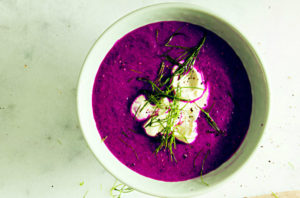
Chilled Beetroot and Cucumber Soup
A beautiful summer soup to make ahead.
Serves 4
4 medium beetroot, boiled peeled and cut into cubes
1 cup cucumber, seeds removed and diced
2 cups chicken stock
1 cup Greek yoghurt
2 tbsp lemon juice
2 tbsp sugar
Salt and freshly ground black pepper
Sour cream to garnish
Chopped fresh dill to garnish
Combine the beetroot, cucumber, stock, yoghurt, lemon juice and sugar and blend until smooth. Do this in two batches if needed. Taste and season with salt and pepper (a possibly a bit more sugar). Cover with cling film and refrigerate overnight. Serve cold, sprinkled with chopped dill and a dollop of sour cream.
WS