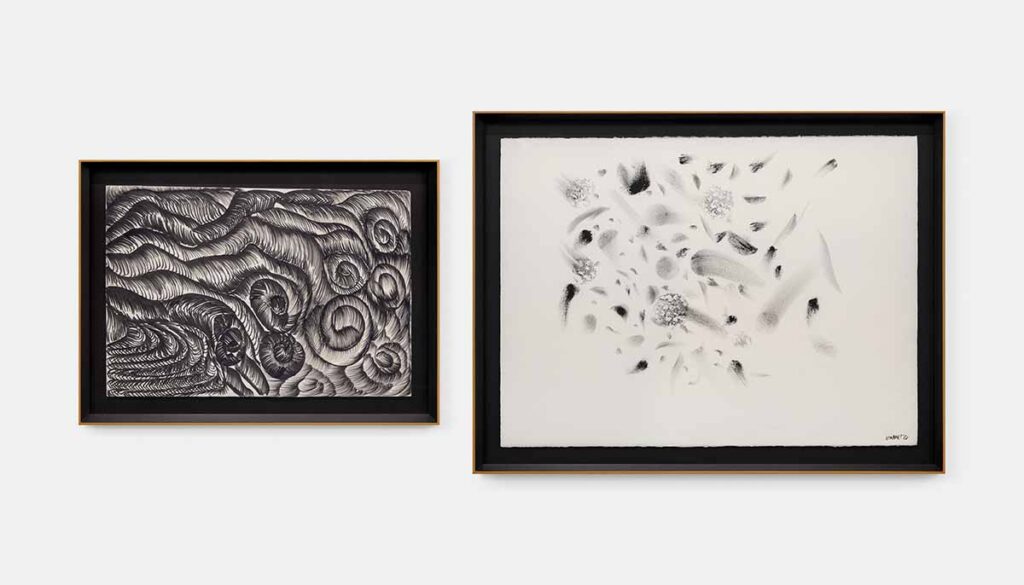
Peffers Fine Art is presenting Sabela Uyabizwa, an exhibition bringing the work of Gladys Mgudlandlu (1917–1979) into dialogue with new responses by Kemang Wa Lehulere (b. 1984).
The Nguni phrase Sabela Uyabizwa may be understood as a summons – respond, you are being called. In the exhibition, this call is both spiritual and formal. It invokes the antiphonal structure of call-and-response, in which listening precedes answer, and in which a response is never mere repetition but a transformation of what has been received.
As Athi Joja writes in the catalogue essay, Mgudlandlu and Wa Lehulere’s works follow this antiphonic relation: the latter is called to respond to the former, yet “a response is not impersonation; each repetition bears its own marks.”
A pairing of works
The exhibition pairs works by Mgudlandlu from Wa Lehulere’s personal collection with newly made works by Wa Lehulere. These pairings are not presented as simple juxtapositions of influence, homage, or historical recovery. Rather, each pair operates as a structure of relation: two works held in dialogue, neither complete without the other. The curatorial brief describes this as a shift from adjacency to completion, in which the two works “do not merely speak to one another; they depend on one another.”
Sabela Uyabizwa also opens in the context of Wa Lehulere’s inclusion in the 61st International Art Exhibition of La Biennale di Venezia, In Minor Keys, the prestigious curated section conceived by the late Koyo Kouoh and carried forward by her curatorial team. His participation in this major international exhibition affirms the wider significance of a practice long concerned with memory, erasure, listening, and the unstable afterlives of history — the very questions that animate his encounter with Mgudlandlu here.
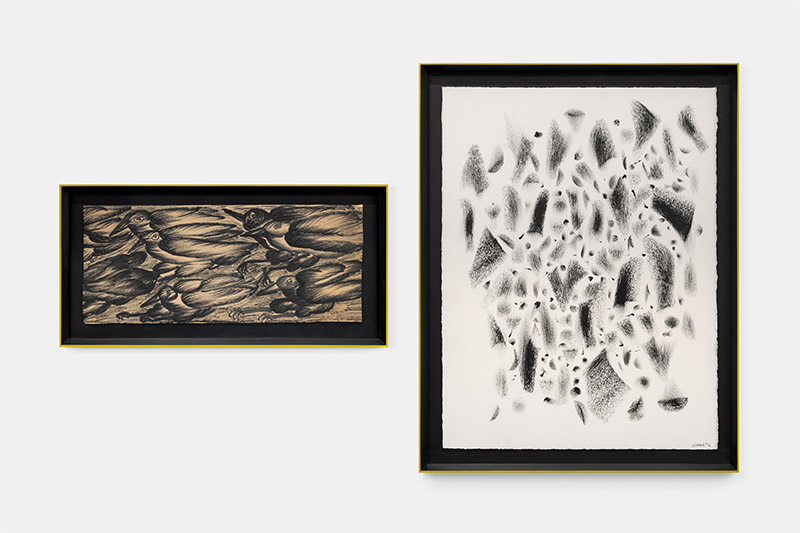
Gladys Mgudlandlu occupies a singular but still under-examined position in South African art history. Long described through limiting categories such as “naïve,” “folk,” or “outsider” art, her work has often been denied the full measure of its formal intelligence. Sabela Uyabizwa foregrounds a less familiar aspect of her practice: dense, abstracted compositions that complicate the prevailing emphasis on her figurative landscapes and township scenes. Joja argues that these early abstract experiments, made in ink and felt-tip marker, “scandalise the historiography of South African art” precisely because Mgudlandlu’s name has so rarely been included in accounts of mid-century abstraction in South Africa.
In these works, Mgudlandlu’s compressed picture planes suggest topographies of vegetation, feather, weather, settlement, and movement. Their tightly worked surfaces create an almost breathless density. Wa Lehulere’s responses receive this density and release it into space. His marks loosen, disperse, and reconfigure Mgudlandlu’s forms, allowing them to drift, echo, and tremble at the edge of disappearance. As the curatorial brief puts it: “Density becomes atmosphere; contour becomes dust; pattern becomes echo.”
Inheriting a damaged cultural history
Wa Lehulere’s engagement with Mgudlandlu is not new. His earlier projects have involved excavation, reconstruction, and archival research, including his recovery of traces of a mural in Mgudlandlu’s former home in Gugulethu. In Sabela Uyabizwa, however, the emphasis shifts from retrieval to response. The exhibition does not attempt to restore an origin intact. Instead, it asks what it means to inherit a damaged cultural history without extracting, domesticating, simplifying, or monumentalising it.
The exhibition also proposes a renewed way of looking at Mgudlandlu’s bird’s-eye view. In an era saturated by satellite imaging, drone optics, logistical mapping, and remote surveillance, her elevated perspective can be understood not as an administrative or territorial gaze, but as a counter-cartography: intimate, fugitive, and visionary. Wa Lehulere does not stabilise this view into legibility. He disperses it through breath, rhythm, song, and afterimage. In this sense, abstraction in Sabela Uyabizwa is not an escape from history, but a means through which buried histories continue to circulate.
At its heart, Sabela Uyabizwa is an exhibition about answerability. Mgudlandlu is not simply honoured as a predecessor; she is met as an active presence. Wa Lehulere is not simply citing her; he agrees to be incomplete without her. The exhibition asks viewers to enter that same relation: to see each pair not as two adjacent works, but as a single field of response, inheritance, and unfinished repair.
More intel
First Thursdays late viewing: Thursday 4 June, 17:00–20:00
Artist walkabout: Saturday 6 June, 11:00
Kemang Wa Lehulere in conversation with Athi Joja: Thursday 11 June, 18:00
Final First Thursdays late viewing: Thursday 2 July, 17:00–20:00
What: Sabela Uyabizwa Gladys Mgudlandlu exhibition with responses by Kemang Wa Lehulere
Where: Peffers Fine Art, First Floor, Radio House, 92 Loop Street, Cape Town
When: Saturday 23 May – Friday 17 July 2026
Gallery hours: Weekdays, 10:00–17:00; weekends by appointment
Call: +27 84 444 8004 | +27 63 772 0661
WS