PLEASE DON’T CALL ME MOFFIE. Written and directed by Zubayr Charles. With Anzio September. Photogrphs: Jeremeo Le Cordeur. Artscape. CHESTER MIGGELS reviews
There are productions that entertain, productions that provoke, and then there are productions that quietly undo you. Please, don’t call me moffie belongs firmly in the latter category. An intimate, emotionally charged one-man play that refuses easy answers while asking difficult questions about faith, masculinity, shame, and survival.
Written and directed by Zubayr Charles and performed by Anzio September, the production is among the more urgent and affecting works currently emerging from South African theatre. Following successful runs at the Suidoosterfees and KKNK, the play has earned widespread praise for its unflinching exploration of queer identity within Cape Malay Muslim and Coloured communities in Cape Town.
The return to Artscape arrives amid another milestone for Charles and September. It was recently announced that Charles’ production This bra’s a psycho has secured two nominations at the Cape Town Theatre Awards, formerly known as the Fleur du Cap Theatre Awards, with Charles recognised in the Best New Director category and September nominated for Best Supporting Performance.
At once intimate and politically resonant, Please, don’t call me moffie confronts difficult themes: masculinity, sexuality, faith, shame and violence, without reducing its characters to symbols of suffering.
The story unfolds through the interconnected lives of Mushfeeq, Abdullah, Zayn, Eesa and Haroon. Five queer Coloured and Cape Malay Muslim friends navigating the uneasy intersection between sexuality, faith and belonging. The production opens with Mushfeeq on the cusp of turning 30, restless and introspective as he scrolls through his phone while reflecting on recurring dreams of his own death. In haunting detail, he imagines the rituals that would follow: his body washed, wrapped and prepared for burial, and the unsettling uncertainty of whether he would find spiritual acceptance in the hereafter.

Layered portrait of lives
The emotional tone shifts sharply when a disturbing video surfaces in the group chat shared by the five friends. The footage depicts two men being violently punished for their sexuality, accompanied by a chilling declaration condemning same-sex desire within Islam. The moment reverberates through the play, acting as both emotional trigger and thematic catalyst. From there, Charles traces the private struggles of each friend as they negotiate fear, intimacy, religious guilt and self-acceptance in markedly different ways. What emerges is a layered portrait of lives shaped by both tenderness and conflict, held together by friendship and fractured by silence.
Charles wisely avoids simplistic binaries. Religion is neither villain nor salvation. Queerness is not framed as uncomplicated liberation. Instead, the playwright situates his characters within deeply human tensions. Between faith and desire, belonging and rejection, visibility and silence.
The play is particularly incisive in its examination of organised religion and the complicated emotional terrain it creates for queer believers. Across many mainstream faith traditions, expressions of sexuality that fall outside religious doctrine are often treated with outright rejection. The familiar refrain, condemning the act while claiming tolerance for the individual, hangs heavily over the emotional world of the production.
Charles captures the psychic cost of this tension with remarkable sensitivity. The pain running through Please, don’t call me moffie feels immediate and deeply human: a yearning not simply to be tolerated, but to belong. Beneath the humour, vulnerability and moments of confrontation lies something profoundly mournful. A longing to remain within the embrace of family, faith and community rather than exist on its margins.
Search for identity
In this way, the play’s central concern extends beyond sexuality alone. At its heart is an urgent search for identity and acceptance within spaces that shape one’s sense of self, even while threatening exclusion. The emotional force of the production lies in that contradiction.
The men at the centre of the play are contradictory in ways that feel authentic. They joke, deflect, posture and perform masculinity even as loneliness and vulnerability quietly surface beneath the surface. Charles writes with empathy, resisting the urge to over-explain or moralise. The result is a script that trusts audiences to sit with discomfort.
The title itself carries enormous emotional weight. “Moffie”, a slur historically weaponised against queer men in South Africa, immediately signals the play’s concerns with naming, shame and survival. Yet Charles transforms the insult into something more layered. A question of who gets to define identity and what remains after years of internalised fear.
If Charles provides the emotional architecture, September supplies the heartbeat.
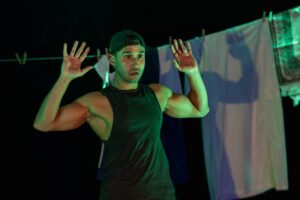
Carrying five distinct characters on stage alone is no small task, yet September navigates the challenge with striking precision. Through subtle shifts in posture, cadence and emotional rhythm, he creates clearly differentiated personalities without ever slipping into caricature.
His performance is strongest in moments of restraint. A hesitation before speaking, a fleeting expression of hurt, a moment of silence stretched just long enough. These become some of the production’s most devastating beats. September understands that vulnerability, not spectacle, carries emotional truth.

Emotionally bruising and brave
The production’s minimalist staging works in its favour. Sparse design choices keep the audience’s attention firmly fixed on performance and text, while domestic imagery quietly reinforces themes of concealment and belonging.
Still, the production is not without shortcomings.
Please, don’t call me moffie occasionally feels constrained by its own ambition. With multiple characters and intersecting themes, some emotional arcs feel only partially developed. There are moments when the play seems to move too quickly through revelations that deserve more space. Yet these are minor criticisms in a work attempting something unusually complex.
More importantly, this is a play that feels necessary.
In a theatrical landscape where queer Muslim and Coloured experiences remain underrepresented, Charles offers visibility rooted not in tokenism, but emotional honesty. These characters are not presented as political statements; they are simply people attempting to reconcile fractured versions of themselves.
Emotionally bruising, brave and anchored by a remarkable performance from Anzio September, this is theatre that lingers long after the lights fade.
What: Please Don’t Call Me Moffie
Where and when: Artscape Theatre, Cape Town, from 2 to 6 June 2026
Tickets: Webtickets
WS