DIE NAG VAN LEGIO. Written by PG du Plessis. Directed by Albert Maritz with André Roothman, Gerben Kamper, Deon Lotz, Duncan Johnson, Hein Poole, Francois Potgieter, Francois Jacobs and Riaan Visman. Lighting by Jako Beylevelt. Set by Gaerin Hauptfleisch. Costumes by Elrina Marais.
TRACEY SAUNDERS reviews
For a script written in the late 1960s to remain as, if not more, gripping and relevant almost five decades later is testament to the emotional insight of the playwright. Die Nag van Legio is such a play.
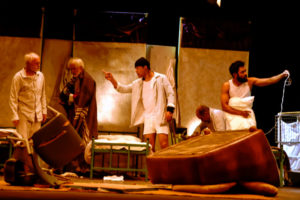
First published in 1969 the magic-realist production was met with disdain and condemnation at the time. The psychological thriller, a battle between good and evil, the knowing and the gullible, is played out in the ward of a psychiatric hospital. Staged in the relatively small Arena Theatre at the Artscape the emotion is distilled and the tension concentrated as the archetypal struggle unfolds. The intensity heightens the sense that none of us are able to escape. The ward has been created with torn regulation hospital green seats, simple iron beds and a psychosis-proof fake aluminium mirror. Renovations in another part of the hospital are tangentially blamed for the run down state of this ward and perhaps explain the detritus of broken chairs, torn books and discarded bed pans that complete the set. It is difficult to watch some of the traumatic scenes and the heightened characterisation of psychiatric illness, without thinking of the tragedy of the Life Esidimeni deaths currently under investigation. As with Jaco Bouwer’s Marat/Sade, staged in February at the Baxter, the parallels between a psychiatric ward and current society, where the delineation between sanity and insanity is contested, is startling.
Characters which lodge themselves firmly in your psyche
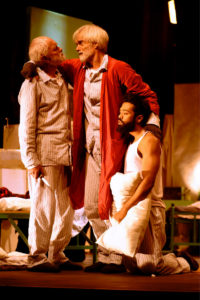
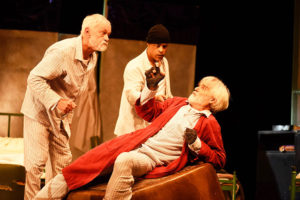
It is to this ward that Dogoman is admitted late one evening. Roothman wears the mercurial malevolence of the mysterious new patient as elegantly as a magician’s cloak. While he may be dressed in a scruffy red bathrobe, such is the success of his bewitching ways that he appears to be cloaked in more magnificent garb. His dark eyes glitter with a fanaticism that was visible from the back of the auditorium and he draws you in with his warped theology and thaumaturgy.
He is suave and slick and his resemblance to a dictatorial orator, a charismatic religious leader or even a democratically elected leader is more than emblematic. A leader’s ability to sway public opinion contrary to any sane logical explanation was analogous to political sentiments in South Africa in the hey day of the apartheid regime and revisiting blind loyalty at the cost of common-sense is a worthwhile exercise now.
Du Plessis, who won the Hertzog Prize for Drama in 1972, creates characters which lodge themselves firmly in your psyche. Each one enigmatic, compelling and uncomfortably recognizable. Dogoman epitomises the beguiling and suave purveyor of dreams and redemption, while each of the other men embody other archetypes, hyper masculinity, innate violence, and misguided intelligence to mention a few. Each one as dispensable as the small wooden pawns in the chess game which stops and starts throughout. As each of the patients succumb to the stranger’s charm you are torn between admonishing their gullibility and admiring his considerable powers of persuasion.
Dark nature of the text
Kamper as Oubaas Menge delivers a brilliant performance. With a shadow of Gregor from Samsa-masjien hovering on the periphery he is immensely watchable. Despite the very dark nature of the text he provides several moments of levity. There really is no adequate English translation for the Afrikaans word bedonnerd and his query, “Wie’s bedonnerd in sy kop?”, followed by an admonishment,”Dis nie goed wat n mens sommer vir ‘n ander man sê nié. Ek sê dit persoonlik nooit vir my ewenaaste nié” and his frequent introduction of a sentence with “Kyk, my kontensie is dit…” provide some of the most entertaining dialogue.
Dirk (Francois Jacobs) seems to be the only one with a semblance of sanity, which in this instance is of course all relative. He has seen Dogoman for what he is and as the tussle between the two intensifies his protestations become increasingly fraught and his emotional torture is heart breaking to observe. Initially defended by his friend Charley (Duncan Johnson), even the limits of that friendship are tested. Johnson’s unravelling is a performance of desperation, the manifestation of a despair so deep that its actions are unfathomable. Jakkie’s (Hein Poole) problematic behaviour, while presented with some uncomfortable comical interpenetration is still distressing. Both he and Claassens (Deon Lotz) portray the more stereotypical behaviours associated with those we consider insane. In equal measure they each display the anguish and bewilderment which accompanies our textbook understanding of “crazy” people and while brilliantly acted, I am uncertain of the merits of fetishising the symptoms of mental instability.
Chilling prescience
The theatrical devices which make the supernatural visible are somewhat of a distraction and the strength of the text is that regardless of any stage trickery, one would believe anything that Dogoman suggests, such is his magnetism. The staging at this historical moment gains an additional chilling prescience during a particularly harrowing scene. As the innocence of a man guilty of the ultimate violation of a twelve year old girl is protested it resonates across the ocean.
I was reminded that heinous acts are not new or exclusive to any one place. Roy Moore may spring to mind in 2017 but no doubt other culprits could have been referenced in the ‘60s in South Africa. The protestation of men who can convince themselves and others of their “innocence” echoes through the decades. This is one of the many aspects that Du Plessis was confronted with when he rewrote the script for an all female cast in 1986. The adaptation required more than just a re-gendering of the characters and Dogoman became Maluna, a distinctly female devil portrayed by Isadora Verwey in the 1990 performance staged by PACOFS at the Bloemfontein Civic Centre. The language is exquisite and I advise you to be wary of succumbing to the hypnotic cadence of Dogoman’s ministrations. They are harder to resist than you could imagine. It is in the awareness of that simplicity of yielding that one gains some sympathy for those who fall prey to the exhortations of snake oil salesmen and parasitic, polished politicians.
A gripping and satisfying piece of theatre
Maritz has pared the script down and says that he has worked finely, “removing the least possible with a scalpel”, a difficult task given the tight structure of the play. It still runs at a substantial one hundred minutes and each moment brings you closer to the edge of your seat. This is a gripping and satisfying piece of theatre and as one sighs with relief once you escape the suffocating grip of Dogoman, you are left with a keen sense of appreciation of this not only as an Afrikaans, but a South African stage classic.
What: Die Nag van Legio
Where and when: Artscape Arena Theatre until 19 November 2017. Matinees on 18 and 19 November
Book: Computicket
WS