OUR WOMEN. Directed by Sifiso Kweyama. Presented by Jazzart Dance Theatre. SHEILA CHISHOLM reviews a short season.
The media’s current focus on the abuse of women and children highlights the role of teachers, counsellors, mothers and grandmothers to listen when a child says they are being abused – then act on that information. Much easier said than done in our impassive, patriarchal society.
However, slowly the message that women and children should be treasured is brought to the fore – one raised voice is Jazzart’s Sifiso Kweyama’s. In his latest offering Our Women he tackles aspects of the urgency for men to treat women and children the way they themselves would like to be treated.
The ‘silence’ of dance
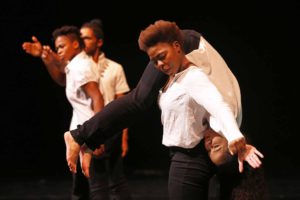
The difficulty about expressing this information through the “silence” of dance is not yet quite overcome. A synopsis telling the idea behind a piece – there were six – doesn’t help unless action reflects it. Which is why when dancers have a voice-over poem linking action, choreography has greater impact.
If A Black Girl Knew by Darion Adams was one such piece. Adams matched movement to words which are (sadly) universal to all cultures.
‘She Walked And I Watched In Awe’
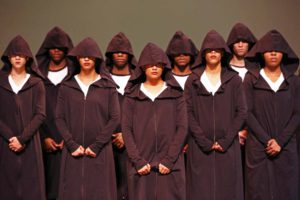
The most important work was Kweyama’s Dankbaar – an expression in movement about nurturing children the same way plants are – for healthy growth. Red towels draped at strategic points lent dramatic effect to the silhouette of an “embryo” seen through the cyclorama. In silence, one by one, six barefoot girls entered. Carrying wellington boots, one by one they put them on. Drawing on their inner rhythms, one beat at a time, in perfect unison, they danced dances normally men’s prerogative.
Building to a climax, they gave birth to a baby boy. As he grew from baby to manhood, jointly the women oversaw the child’s development, emphasising the importance of women in today’s world. An excellent work, exceptionally well-danced by second year trainees.
Kweyama’s She Walked And I Watched In Awe carefully followed his synopsis concerning society’s expectations of women’s behaviour. He costumed three girls in grey frock-coats, and two in “fold up” crinolines while one, bucket on her head, walked round the stage, intermittently joining her “sisters” in energetic dances, before completing her walk.
Courtney Smith’s Womentally didn’t match her love story, neither did Vuyolwethu Nompetsheni’s Akekho Owaziyo solo exploring the life of a child with a decorated car tyre.
Mziyanda Mancam’s Insight also became an exercise in energetic movement rather than a journey of a woman in love. Disappointing as those works were, the energy, athleticism and purpose the students showed bodes well for their future in the contemporary dance scene.
Our future dancing generation began the evening with 14 children from Jazzart’s public spirited programme. While they performed wriggles, runs, jumps in a youngster’s version of the Stick Dance, a remarkably confident five year-old stole the show.
What: Jazzart Dance Theatre Our Women
WS